
YT NT NU BC AB SK MB ON QC NB NL NS PE
On this page:
- Key Takeaways
- Electricity and Renewable Energy Trends
- Recent and Planned Renewable Electricity and Energy Storage Projects
Yukon
Yukon’s electricity generation is predominantly hydroelectric, supported by diesel and liquefied natural gas (LNG) for meeting peak demand and supplying off-grid communities. The territory’s electricity system is primarily managed by Yukon Energy—a Crown corporation responsible for generation and transmission, while ATCO Electric Yukon oversees distribution and owns a few generating units. LNG is transported by truck from facilities in Fort Nelson, British Columbia (and occasionally Elmworth, Alberta), and stored at Yukon Energy’s Whitehorse plant. There, it is regasified and burned to generate electricity during winter peaks or when hydroelectric output is low. Yukon is the only territory with a centralized electric grid that connects most communities, although it remains isolated from the broader North American grid.
Key Takeaways
- In 2023, Yukon generated 559.2 gigawatt-hours (GWh) of electricity, with 490.8 GWh (87.8%) coming from renewable sources.
- Renewable capacity grew from 79 megawatts (MW) in 2010 to 104 MW in 2023, a 31.6% increase. Most of this growth came from hydroelectricity (20 MW), wind (3 MW) and solar (2 MW).
Electricity and Renewable Energy Trends
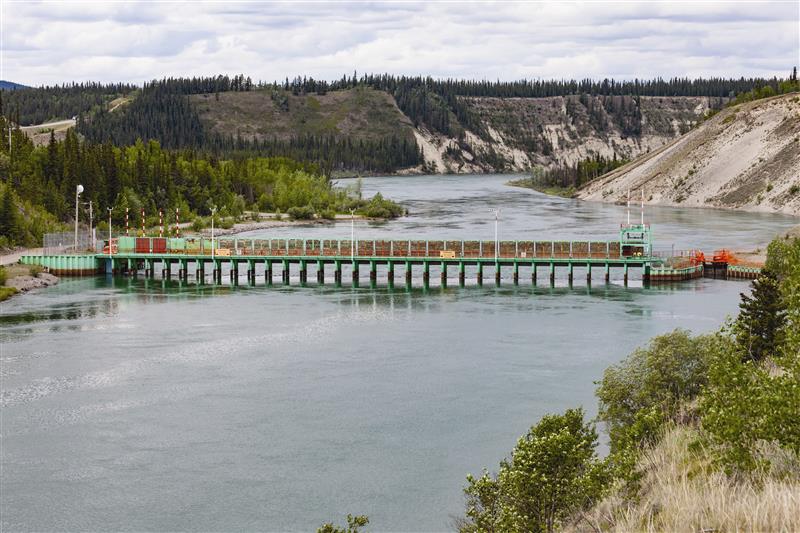
In 2023, hydroelectricity accounted for 87.3% of Yukon’s grid-connected generation. The territory’s major hydroelectric stations at Whitehorse, Aishihik, and Mayo provide reliable baseload power. However, hydroelectricity output can fluctuate year to year due to variability in precipitation levels.
Despite its renewable energy base, Yukon continues to rely on thermal generation—including diesel and natural gas—to meet peak demand and serve isolated communities not connected to the main grid. These sources accounted for 5.7% and 6.5% of total generation in 2023, respectively. Between 2010 and 2023, natural gas capacity increased by 13 MW, while permanent petroleum-fired capacity declined by 12 MW. Both LNG and diesel remain key fuels for meeting reliability needs, Yukon Energy has rented portable diesel generators during winter months (typically December to April) to cover peak demand, which offsets the decline in permanent diesel capacity.
Although Yukon's generation remains hydroelectricity-dominated, growing electricity demand has led to increased use of natural gas and continued use of diesel, with small growth in solar and wind.
To support long-term electricity needs, investments in grid upgrades and an interconnection study with British Columbia is underwayFootnote 1. These initiatives aim to enhance grid reliability and access to electricity, while reducing reliance on costly imported fuels and enabling greater integration of local renewable sourcesFootnote 2.
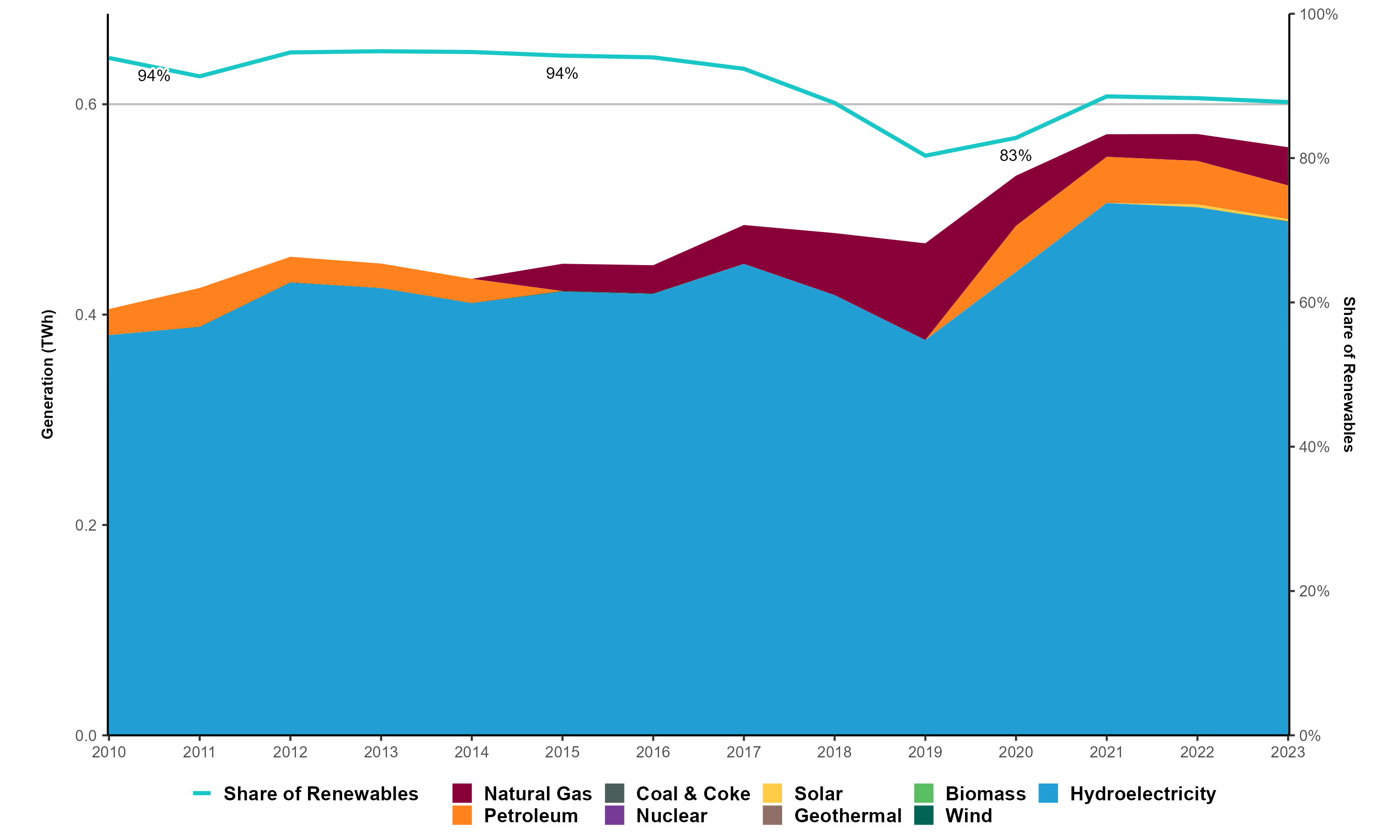
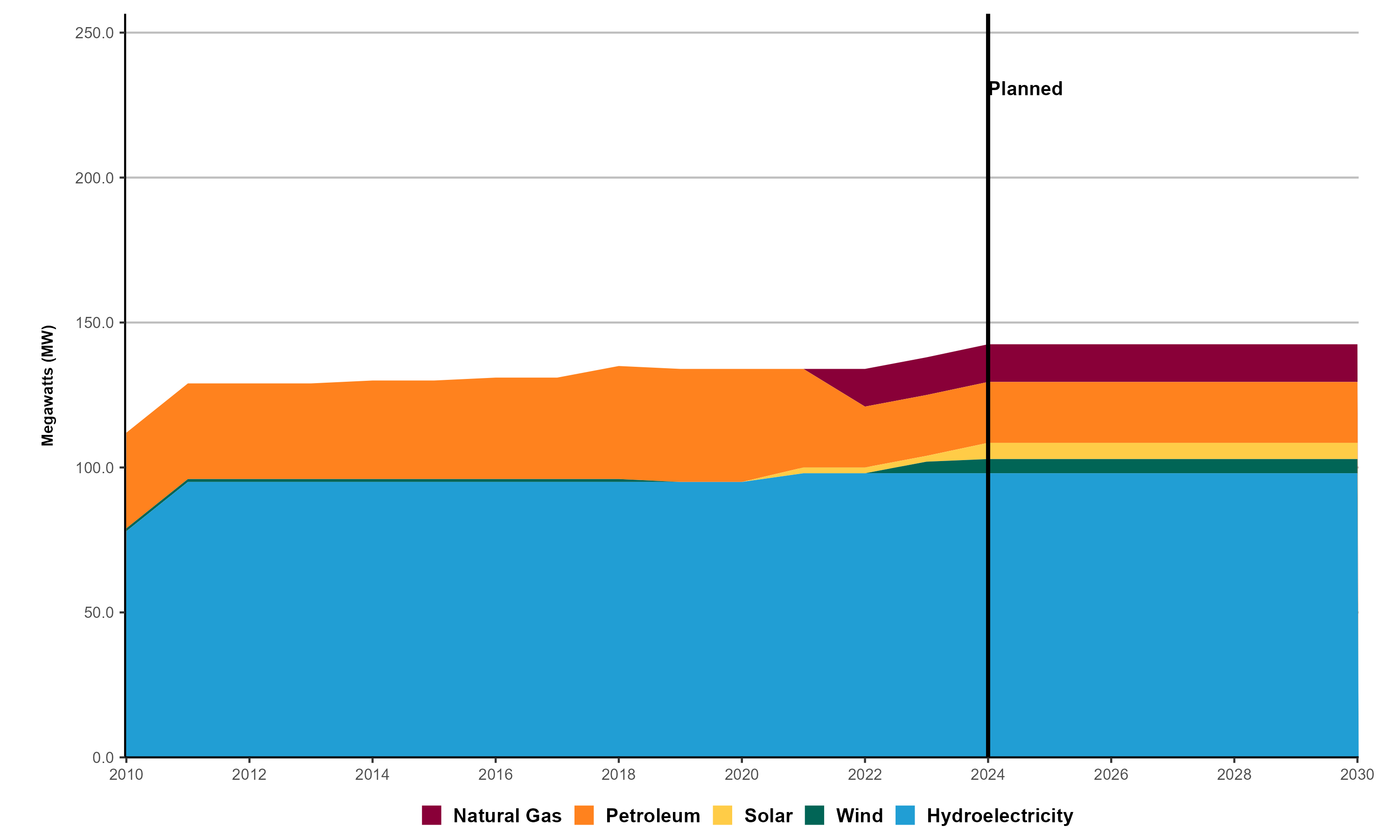
Figures 1 and 2 show historical trends in generation and installed capacity, respectively. Figure 2 also includes planned capacity additions for 2024–2030. The planned portion of the figure may be conservative; additional projects could be announced and come online before 2030, and some projects in the outlook might not proceed.
Figure 1: Electricity Generation by Type in Yukon
Source and Text Alternative
Source: The primary source for electricity generation data comes from Statistics Canada. Table 25-10-0020-01, 25-10-0084-01, and 25-10-0028-01 are combined to display data for all categories and years.
Data: Electricity Generation by Type in Yukon [XLSX 20 KB]
Text Alternative: This graph illustrates electricity generation from 2010 to 2023 in Yukon. In 2010, Yukon’s total generation was 405.3 GWh (93.9% renewable). In 2023, total generation was 559.2 GWh (87.8% renewable). Most generation in 2023 came from hydroelectricity (87.3%), natural gas (6.5%), and petroleum (5.7%).
Figure 2: Electricity Capacity and Future Changes in Yukon
Source and Text Alternative
Source: The primary source for electricity generation capacity data comes from Statistics Canada. Table 25-10-0022-01 and Table 25-10-0023-01 are combined to display data for all of the categories. It is supplemented by additional project-level data for planned capacity from provincial governments, utilities, and system operators, as well as industry associations.
Data: Electricity Capacity and Future Changes in Yukon [XLSX 20 KB]
Text Alternative: This graph illustrates historical electricity generation capacity from 2010 to 2030 in Yukon. In 2010, the province’s total installed electricity capacity was 112 MW (70.5% renewable). In 2023, capacity grew to 138 MW (75.4% renewable). In 2030, based on planned capacity additions, capacity reaches 143 MW (76.1% renewable).
Yukon has 1.6 MW of battery energy storage (BESS) operational, and 7 MW under construction. Two solar-plus-storage systems are already in service in Old Crow (2021)Footnote 3 and Beaver Creek (2025)Footnote 4. A 7 MW energy storage system is also set to come online in the next few years in WhitehorseFootnote 5.
In 2023, the territory had 6.7 MW of distributed solar power capacityFootnote 6.
Yukon launched its biomass energy strategy in 2016 to support heating and leverage resources from its forestry sector. Biomass boiler capacity grew from zero in 2010 to over 5 MW by 2023 in community, light industrial, institutional, commercial, and agricultural sectorsFootnote 7. Biomass is considered a key resource in meeting Yukon’s goal of 30% non-mining renewable energy by 2030.
Recent and Planned Renewable Electricity and Energy Storage Projects
This section highlights selected renewable electricity and energy storage projects in Yukon, either recently completed or planned for development between 2025 and 2030. This list is not comprehensive and is based on information available as of September 2025.
- The White River First Nation’s Saa/Se Energy Project – A solar and BESS project in Beaver Creek, owned by White River First Nation, added 1.8 MW of capacity and 3.5 MWh of storage in 2025Footnote 8.
- Whitehorse Battery Energy Storage Project – A grid-scale BESS owned by SunGrid Solutions in collaboration with the Kwanlin Dün First Nation and Ta’an Kwäch’än Council, plans to add 7 MW of battery storage by 2025Footnote 9.
- Sādę Solar Initiative Project – A 2.85 MW solar power plant with a battery energy storage system owned by the Government of Yukon, First Kaska Utilities LP, and the Government of Canada, plans to become fully operational by summer 2027Footnote 10.
- Date modified: