
YT NT NU BC AB SK MB ON QC NB NL NS PE
On this page:
- Key Takeaways
- Electricity and Renewable Energy Trends
- Recent and Planned Renewable Electricity and Energy Storage Projects
Quebec
With over 99% of its electricity generation coming from renewable sources, Quebec has one of the lowest-emitting electricity grids in Canada and the world. Leveraging abundant hydroelectric capacity, Quebec is Canada’s largest electricity exporter, supplying power to markets in Ontario, the Maritime provinces, New York, and New EnglandFootnote 1.
Quebec has a provincially regulated electricity system, operated by Hydro-Québec, a Crown corporation, responsible for generation, transmission, and distribution. The Régie de l’énergie du Québec oversees electricity rates and system reliability. Hydroelectricity, from more than 60 large stations, forms the backbone of Quebec’s low-cost, stable electricity supply. Numerous smaller private and community-owned facilities contribute to overall generation capacityFootnote 2.
Key Takeaways
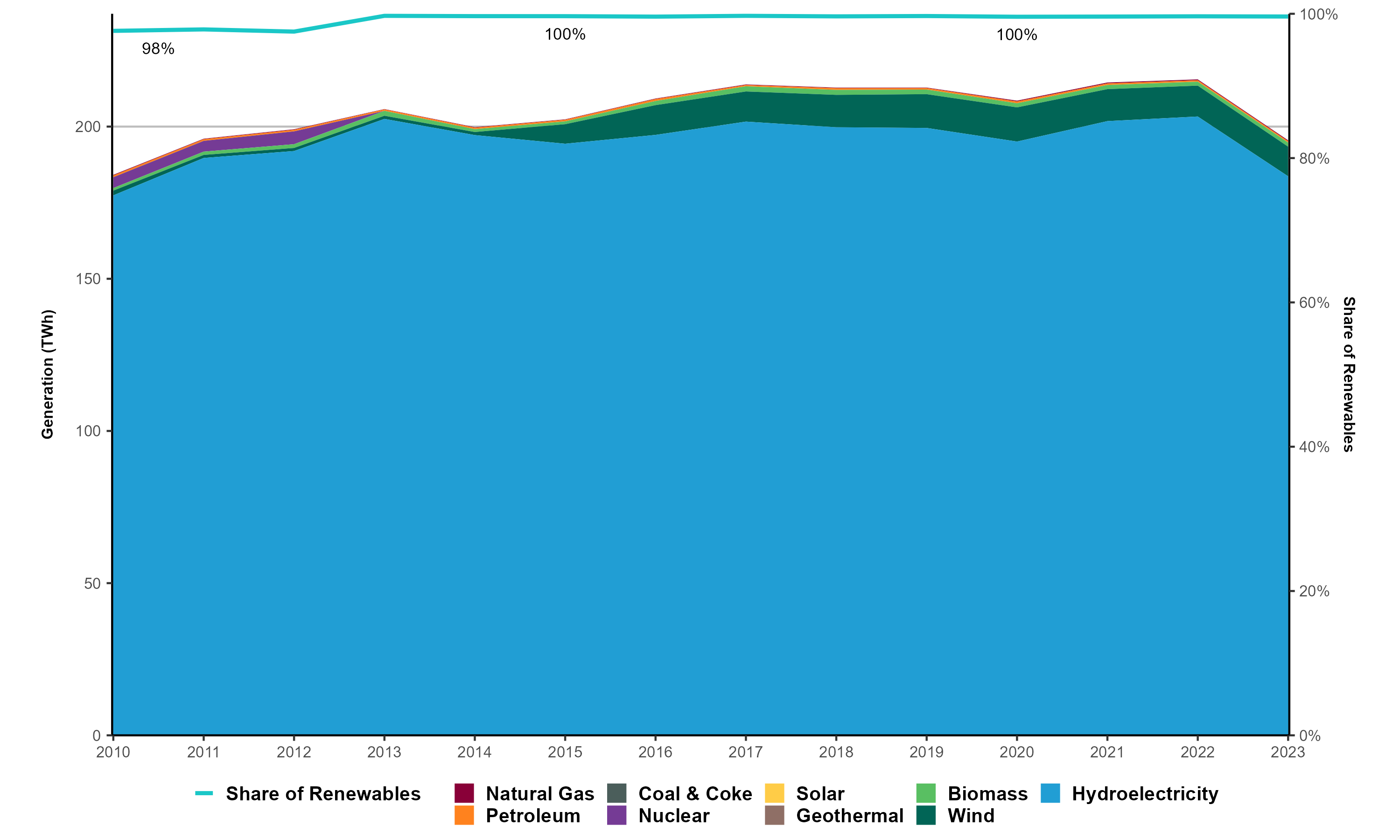
- In 2023, Quebec generated 195.5 terawatt-hours (TWh) of electricity, with 194.8 TWh (99.6%) coming from renewable sources.
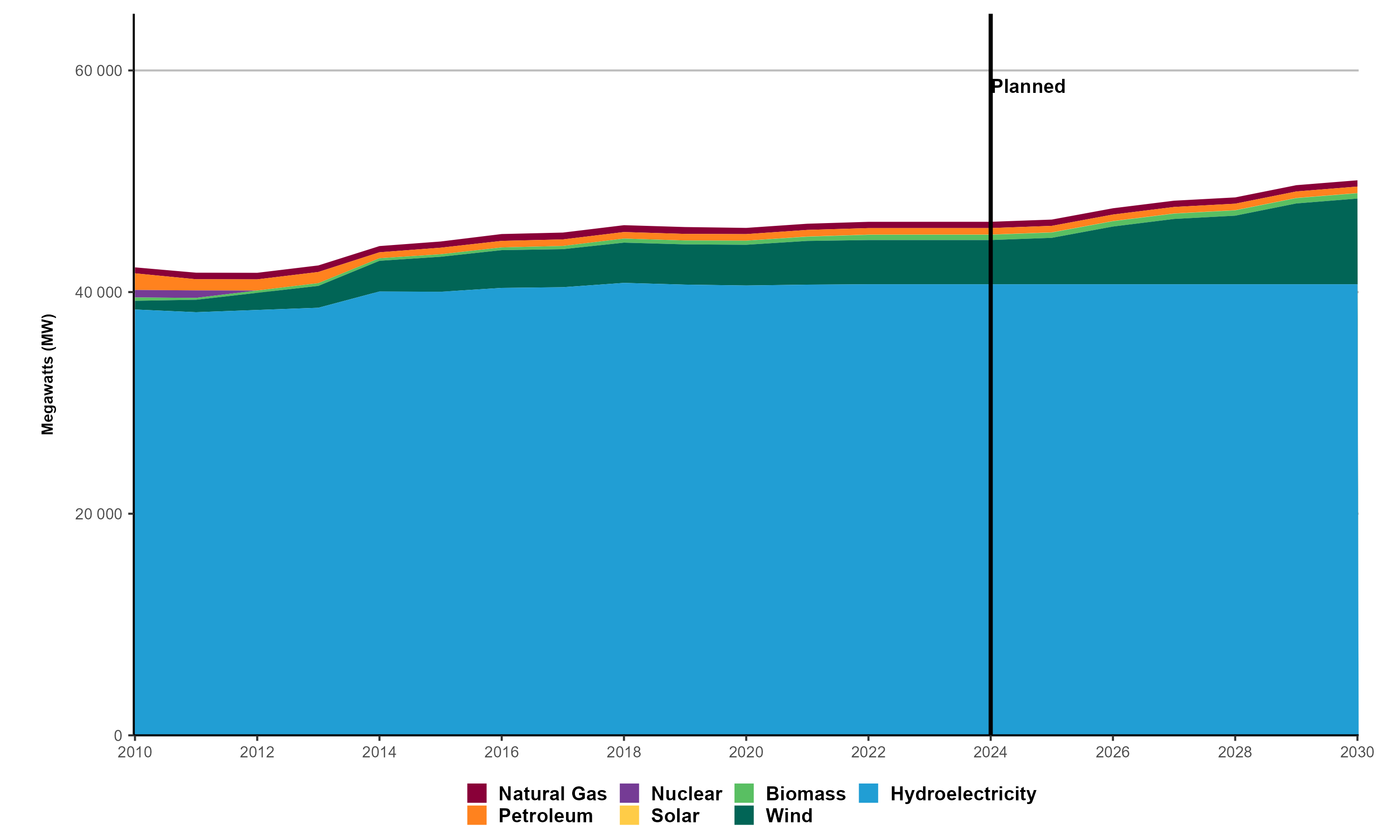
- Renewable capacity grew from 39,515 megawatts (MW) in 2010 to 45,189 MW in 2023, a 14.4% increase. Most of that growth came from wind (3,206 MW) and hydroelectricity (2,276 MW), while biomass also added 180 MW. Most of the province’s generation capacity came from hydroelectricity in 2023, at 87.8%.
Electricity and Renewable Energy Trends
Quebec’s electricity system has a large hydroelectric base, which supplied 94% of generation in 2023, supplemented by gradual growth in wind and other renewable sources. Wind capacity expanded significantly between 2010 and 2023, increasing by 408% to 3,992 MW. Two new rounds of wind energy procurements will further expand wind capacity in upcoming yearsFootnote 3. Solar capacity remains minimal at 12 MW.
Quebec has long benefited from a 1969 agreement with Newfoundland and Labrador for low-cost electricity from the Churchill Falls Generating Station, originally set to expire in 2041. In 2024, the two provinces signed a new non-binding agreement-in-principle to renew access to Churchill Falls’ existing output at a competitive price and to pursue new hydroelectric projects in Labrador. The agreement-in-principle outlines upgrades to the Churchill Falls station and potential new developments, notably at Gull Island, which would bring total capacity in Labrador to 9,190 MW, of which 7,200 MW could eventually be purchased by Hydro-QuébecFootnote 4.
In 2023, Hydro-Québec released its Action Plan 2035Footnote 5, outlining $185 billion in investments by 2035 to transform Québec’s electricity system and pave the way toward doubling electricity generation by 2050. The Plan includes the development of 11,000 MW of new clean electricity in the next decade, with over 10,000 MW of new wind power installed capacity, and the addition of 5,000 km of transmission lines.
Figures 1 and 2 show historical trends in generation and installed capacity, respectively. Figure 2 also includes planned capacity additions for 2024–2030. The planned portion of the figure may be conservative; additional projects could be announced and come online before 2030, and some projects in the outlook might not proceed.
Figure 1: Electricity Generation by Type in Quebec
Source and Text Alternative
Source: The primary source for electricity generation data comes from Statistics Canada. Table 25-10-0020-01, 25-10-0084-01, and 25-10-0028-01 are combined to display data for all categories and years.
Data: Electricity Generation by Type in Quebec [XLSX 21 KB]
Text Alternative: This graph illustrates electricity generation from 2010 to 2023 in Quebec. In 2010, Quebec’s total generation was 184.2 TWh (97.6% renewable). In 2023, total generation was 195.5 TWh (99.6% renewable). Most generation in 2023 came from hydroelectricity (94.0%), wind (5.0%), and biomass (0.7%).
Figure 2: Electricity Capacity and Future Changes in Quebec
Source and Text Alternative
Source: The primary source for electricity generation capacity data comes from Statistics Canada. Table 25-10-0022-01 and Table 25-10-0023-01 are combined to display data for all of the categories. It is supplemented by additional project-level data for planned capacity from provincial governments, utilities, and system operators, as well as industry associations.
Data: Electricity Capacity and Future Changes in Quebec [XLSX 21 KB]
Text Alternative: This graph illustrates historical electricity generation capacity from 2010 to 2030 in Quebec. In 2010, the province’s total installed electricity capacity was 42,230 MW (94.0% renewable). In 2023, capacity had grown to 46,343 MW (97.5% renewable). In 2030, based on planned capacity additions, capacity reaches 50,088 MW (97.7% renewable).
Quebec has around 7 MW of battery energy storage (BESS), with no other energy storage currently planned before 2030.
In 2023, the province had 9 MW of distributed solar power capacityFootnote 6.
Quebec had around 190 million liters of ethanol and around 40 million liters of biodiesel capacity in 2024. The province has a 5% renewable natural gas (RNG) mandate by 2025, targeting 10% by 2030. Lachenaie landfill is one of Canada’s largest RNG sites (2.9 PJ/year), and the Sainte-Sophie landfill is planned to add ~2.5 PJ by 2026Footnote 7. In 2023, Quebec produced 45 PJ of pulping liquor and 98 PJ of solid biofuels, including 1.2 million tonnes of wood pellets. Quebec is also the country’s largest user of bioheat, with 190 MW of biomass boiler capacity in community, light industrial, institutional, commercial, and agricultural sectors.
Recent and Planned Renewable Electricity and Energy Storage Projects
This section highlights selected renewable electricity and energy storage projects in Quebec, either recently completed or planned for development between 2025 and 2030. This list is not comprehensive and is based on information available as of September 2025.
- Manicouagan Wind Project – A wind project owned by Innergex Renewable Energy in partnership with the Innu Council of Pessamit and the Regional County Municipality of Manicouagan, plans to add 300 MW of wind capacity in 2030Footnote 8.
- Pohénégamook – Picard – Saint-Antonin – Wolastokuk – A wind project owned by Invenergy and the Alliance de l’énergie de l’Est, plans to add 349.8 MW of wind capacity by 2026, and an additional 291.4 MW by 2030Footnote 9.
- Arthabaska Wind Farm – A wind project owned by Boralex in partnership with the Regional County Municipality of Arthabaska, plans to add 265.2 MW of wind capacity in 2030Footnote 10.
- Apuiat Wind Project – A wind project owned by Boralex and the Innu communities of the Côte-Nord region, plans to add 200 MW of wind capacity in 2025Footnote 11.
- Saint-Paul-de-Montminy Wind Project – A wind project owned by Kruger Energy in partnership with the Alliance de l’énergie de l’Est and the Wolastoqiyik Wahsipekuk First Nation, plans to add 196 MW of wind capacity in 2027Footnote 12.
- Date modified: