
YT NT NU BC AB SK MB ON QC NB NL NS PE
On this page:
- Key Takeaways
- Electricity and Renewable Energy Trends
- Recent and Planned Renewable Electricity and Energy Storage Projects
Alberta

Alberta, one of the sunniest and windiest provinces in Canada, historically relied on coal and natural gas for electricity generation.Footnote 1 Since 2010, the province shifted its energy mix by adding substantial wind and solar capacity while fully phasing out coal in 2024.Footnote 2 In August 2023, the province imposed a six-month pause on approvals for large renewable projects to review land-use, grid, and reclamation rules.Footnote 3 The pause ended in early 2024, when new siting restrictions and reclamation requirements for renewable projects were introduced.Footnote 4
The province has a deregulated electricity market overseen by the independent Alberta Electric System Operator (AESO).Footnote 5 The Alberta Utilities Commission (AUC) regulates utilities as well as electric transmission and distribution infrastructure.Footnote 6 Electricity producers and distributors file with the Alberta Utilities Commission and follow AESO processes to connect to the grid and sell electricity through a competitive bidding process, allowing investors to choose the type and scale of generation projects they wish to develop.
Key Takeaways
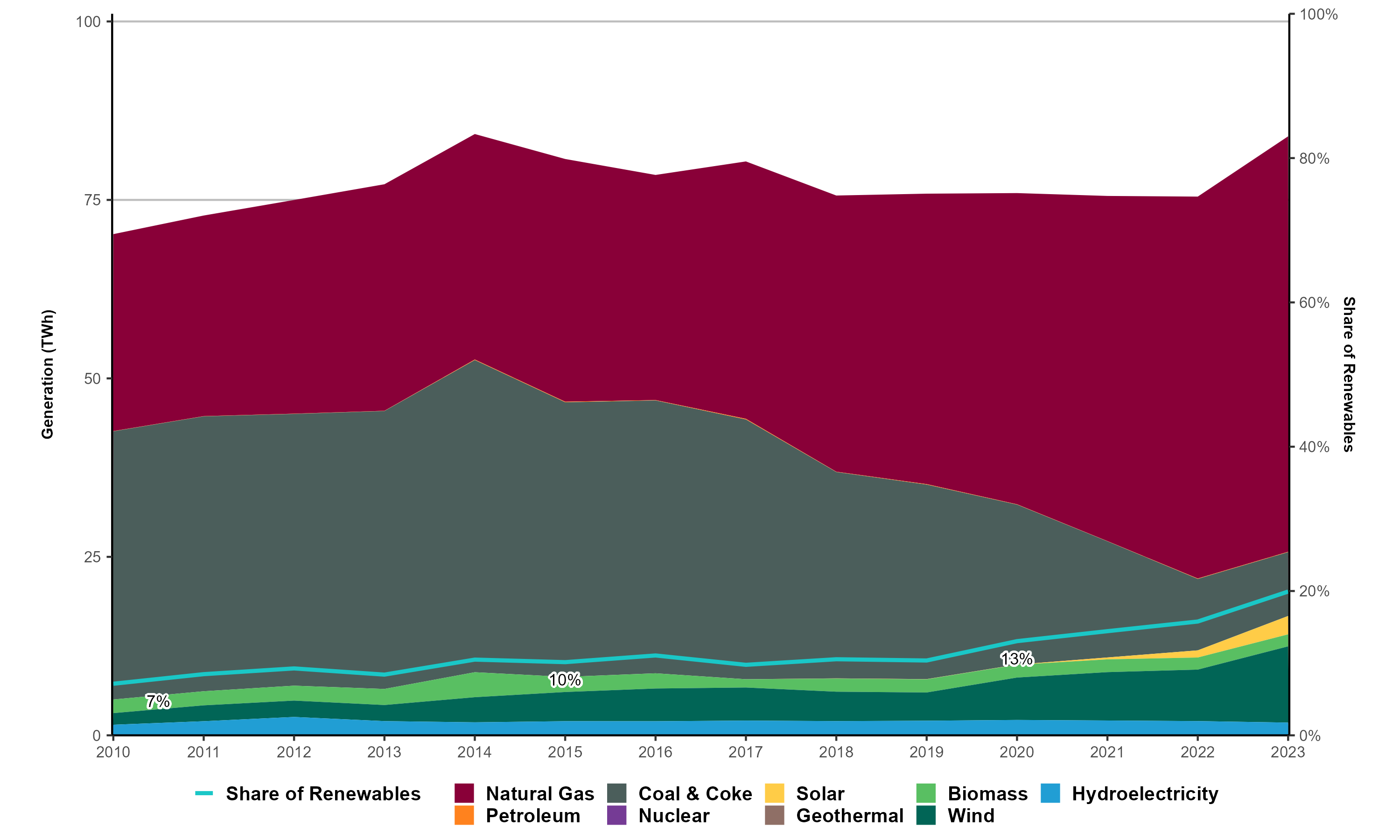
- In 2023, Alberta generated 83.9 terawatt-hours (TWh) of electricity, with 16.7 TWh (19.9%) coming from renewable sources.
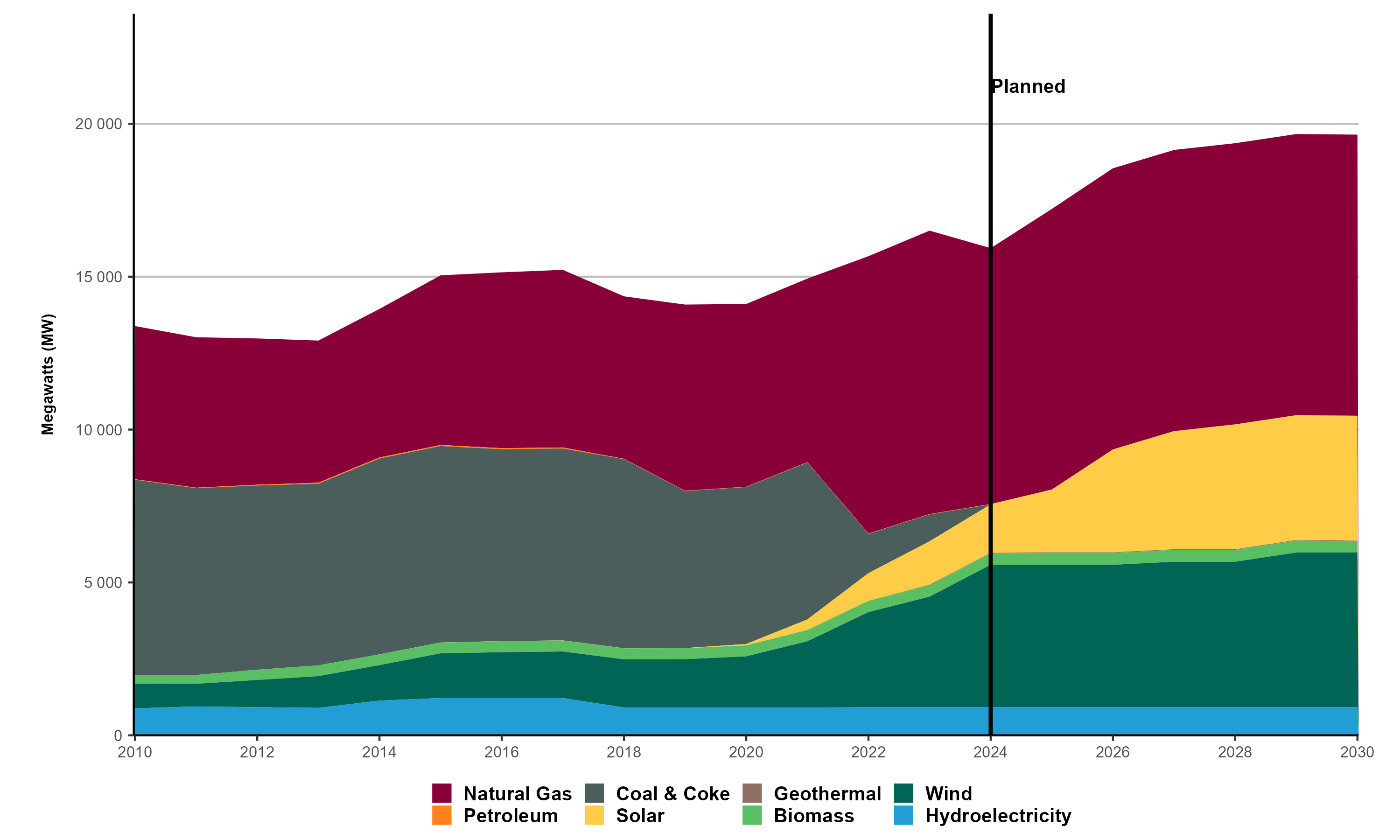
- Renewable capacity grew from 1,976 megawatts (MW) in 2010 to 6,346 MW in 2023, a 221% increase. Most of this growth came from wind (2,812 MW), followed by solar (1,421 MW), and biomass (83 MW).
Electricity and Renewable Energy Trends
Alberta completed its phase out of coal-fired generation in 2024, with most plants converted to natural gas—either through boiler modification or by combining a combustion turbine with existing steam generators. Wind and solar have seen significant growth. Wind capacity reached 3,618 MW in 2023, contributing 21.9% of total generation capacity. Alberta has a relatively long history with wind energy, as commercial wind developments commenced in southern Alberta in the mid-1990s.Footnote 7
Wind generation contributed 10.7 TWh in 2023. Solar capacity also expanded significantly in recent years, notably with the Travers Solar Project (465 MW) becoming Canada’s largest solar installation to dateFootnote 8, generating 2.6 TWh of solar in 2023, and bringing up total provincial solar capacity to 1,421 MW.
Figures 1 and 2 show historical trends in generation and installed capacity, respectively. Figure 2 also includes planned capacity additions for 2024–2030. The planned portion of the figure may differ from what gets built; additional projects could be announced and come online before 2030, and some projects might not proceed.
Figure 1: Electricity Generation by Type in Alberta, 2010-2023
Source and Text Alternative
Source: The primary source for electricity generation data comes from Statistics Canada. Table 25-10-0020-01, 25-10-0084-01, and 25-10-0028-01 are combined to display data for all categories and years.
Data: Electricity Generation by Type in Alberta, 2010-2023 [XLSX 21 KB]
Text Alternative: This graph shows electricity generation from 2010 to 2023 in Alberta. In 2010, Alberta’s total generation was 70.2 TWh (7.1% renewable). In 2023, total generation was 83.9 TWh (19.9% renewable). Most generation in 2023 came from natural gas, followed by wind and coal.
Figure 2: Electricity Capacity and Future Changes in Alberta
Source and Text Alternative
Source: The primary source for electricity generation capacity data comes from Statistics Canada. Table 25-10-0022-01 and Table 25-10-0023-01 are combined to display data for all of the categories. It is supplemented by additional project-level data for planned capacity from provincial governments, utilities, and system operators, as well as industry associations.
Data: Electricity Capacity and Future Changes in Alberta [XLSX 21 KB]
Text Alternative: This graph illustrates historical electricity generation capacity from 2010 to 2030 in Alberta. In 2010, the province’s total installed electricity capacity was 13,386 MW (14.8% renewable). In 2023, capacity had grown to 16,507 MW (38.4% renewable). In 2030, based on planned capacity additions, capacity reaches 19,647 MW (53.1% renewable).
Alberta's Microgeneration RegulationFootnote 9 allows residents to generate electricity from renewable sources and sell surplus to the grid. As of August 2025, microgeneration capacity totaled 335 MW, a significant increase from 258 MW a year earlier, with solar accounting for 96.5% in August 2025.Footnote 10
Currently, Alberta has approximately 271 MW of energy storage capacity, with up to 180 more MW planned to be under construction in the near term. All projects are battery energy storage system (BESS), which are partly supported by Alberta’s Technology Innovation and Emissions Reduction System. Additionally, in July 2025, the AESO announced intention to procure up to 750 MW of ancillary services for Fast Frequency Response Plus—its intertie restoration initiative—which is expected to largely be supplied by BESS technologiesFootnote 11.
Alberta has significant bioenergy capacity with two wheat-based ethanol plants—a combined capacity of 80 million liters per year—as well as Canada’s largest biodiesel facility, which produces 265 million liters annually. The Strathcona biorefinery, which is the country’s largest renewable fuel facility with a 1.16 billion liters per year capacity, started operations in July 2025. Alberta had 0.7 PJ of renewable natural gas (RNG) capacity in 2024, which is planned to grow to 5 PJ by 2026—much of it designated for British Colombia (B.C.). Alberta also produced approximately 37 PJ of solid wood fuels and pulping liquor in 2023 and operates 5 wood pellet plants with a total capacity of 750,000 tonnes per year.
Alberta is also exploring the use and expansion of its geothermal resources, an emerging technology in Canada. In 2023, Canada's first commercial hybrid geothermal power plant began operating in Swan Hills, Alberta. The project combines geothermal and natural gas to produce 21 MW of electricityFootnote 12.
Recent and Planned Renewable Electricity and Energy Storage Projects
This section highlights selected renewable electricity and energy storage projects in Alberta, either recently completed or planned for development between 2025 and 2030. This list is not comprehensive and is based on information available as of September 2025.
- Homestead Solar Project – A solar project owned by Greenwood Sustainable Infrastructure, plans to add 400 MW of solar capacity by 2026Footnote 13.
- Brooks Solar Farm – A solar project developed by Solar Kraft and Beargrass Solar JV, plans to add 360 MW of solar capacity between 2024 and 2026Footnote 14.
- Bull Trail Wind Project – A wind project owned by EDF Renewables, plans to add 300 MW of wind capacity by 2029Footnote 15.
- Jurassic Solar and Battery Storage – A solar and battery storage project developed by Jurassic Solar L.P (Northland Power), plans to add 220 MW of solar capacity and 80 MW of battery storage by 2028Footnote 16.
- eReserve Program – A group of battery energy storage projects developed by Enfinite, added 180 MW of capacity between 2020 and 2024Footnote 17.
- Killarney Lake Solar and Battery Storage Project – A solar and battery energy storage project developed by Montana First Nation, plans to add 22.5 MW of solar capacity and 100 MW of storage by 2026Footnote 18.
- Date modified: