
Canada Energy Regulator Safety Culture Work Plan 2026–2029
Canada Energy Regulator Safety Culture Work Plan 2026–2029 [PDF 434 KB]
Background
The CER’s safety culture work is part of the regulator’s broader safety and environment oversight (SEO) strategy for preventing harm to people and the environment. A company’s culture influences the actions and decisions of people within it. As a result, it can positively or negatively impact safety and environmental protection performance. Companies that continually foster a healthy safety culture build strong defenses that can help prevent major accidents. For this reason, the CER has committed to working alongside industry to build an understanding of what safety culture is and how companies can continually improve it.
To support the CER’s SEO strategy, two safety culture goals were established in 2020: System-wide Influence and Company Performance.
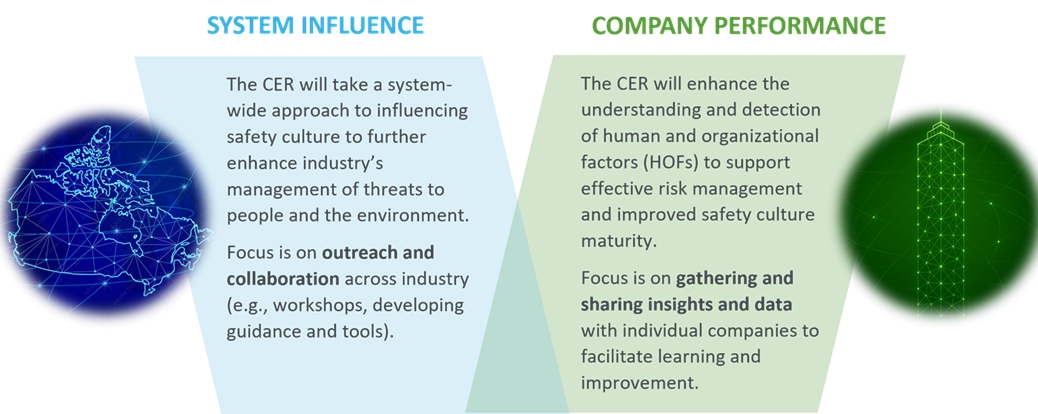
These goals remain the drivers for the regulator's safety culture strategy and work plan through 2029. They are intended to balance our efforts on both industry-wide influence and company-specific advancements in safety and environmental protection by:
- Understanding that the CER is part of the broader safety system, and to improve it, we must collaborate with others to learn and improve together; and
- Supporting companies to enhance their abilities to detect and manage workplace system issues (i.e., human and organizational factors).
Past CER safety culture work has included:
- Development of a Statement on Safety Culture documenting the CER’s safety culture framework;
- Hosting of annual industry workshops to facilitate collective learning;
- Creation of an external, web-based Learning Portal to share practical tools and guidance for industry’s use; and
- Annual surveys to evaluate the regulator’s effectiveness and value added by efforts to support continual improvement.
Looking Ahead (2026–29)
To continue influencing safety culture advancement across industry, the CER will:
- Develop and publish relevant guidance and tools for use by industry;
- Facilitate industry-wide learning by bringing different parts of the oil and gas safety system together to collaborate on relevant topics; and
- Pilot new methods for collecting, interpreting, and sharing organizational insights with companies to improve understanding and management of performance influencing factors.
Activities for 2026-29
The following activities are planned through 2029 in accordance with the above objectives:
- Planning and executing annual safety culture workshops with industry;
- Releasing the annual Departmental Results Framework (DRF) survey to measure CER effectiveness in this area of safety culture and to inform focus areas that meet industry needs as they evolve year-over-year;
- Chairing the North American Regulators Working Group on Safety Culture, including development of related research and work products;
- Creating and publishing additional Learning Portal guidance, tools and educational content (e.g., leadership tool kit, e-learning modules, implementation considerations when moving from theory to practice);
- Building internal CER staff capacity through socialization, education and the development of a HOF competency framework;
- Outreach and engagement with industry, academia, and other regulators; and
- Analysis and recommendations for regulation, guidance and/or standards improvement, including participating in the development of a new edition of CSA Express Document 16:22 entitled Human and Organizational Factors for Optimal Pipeline Performance (i.e., add new, relevant content to the first edition published in 2022)
Evaluation and Continual Improvement
To evaluate the effectiveness of the major activities described in this plan, the CER will collect feedback from industry via the DRF safety culture survey and participant observations following industry outreach (e.g., safety culture workshops). The data collected will continue to inform these activities and facilitate course correction, as necessary.
- Date modified: