Your feedback will help us improve and better meet your needs (opens in new tab)
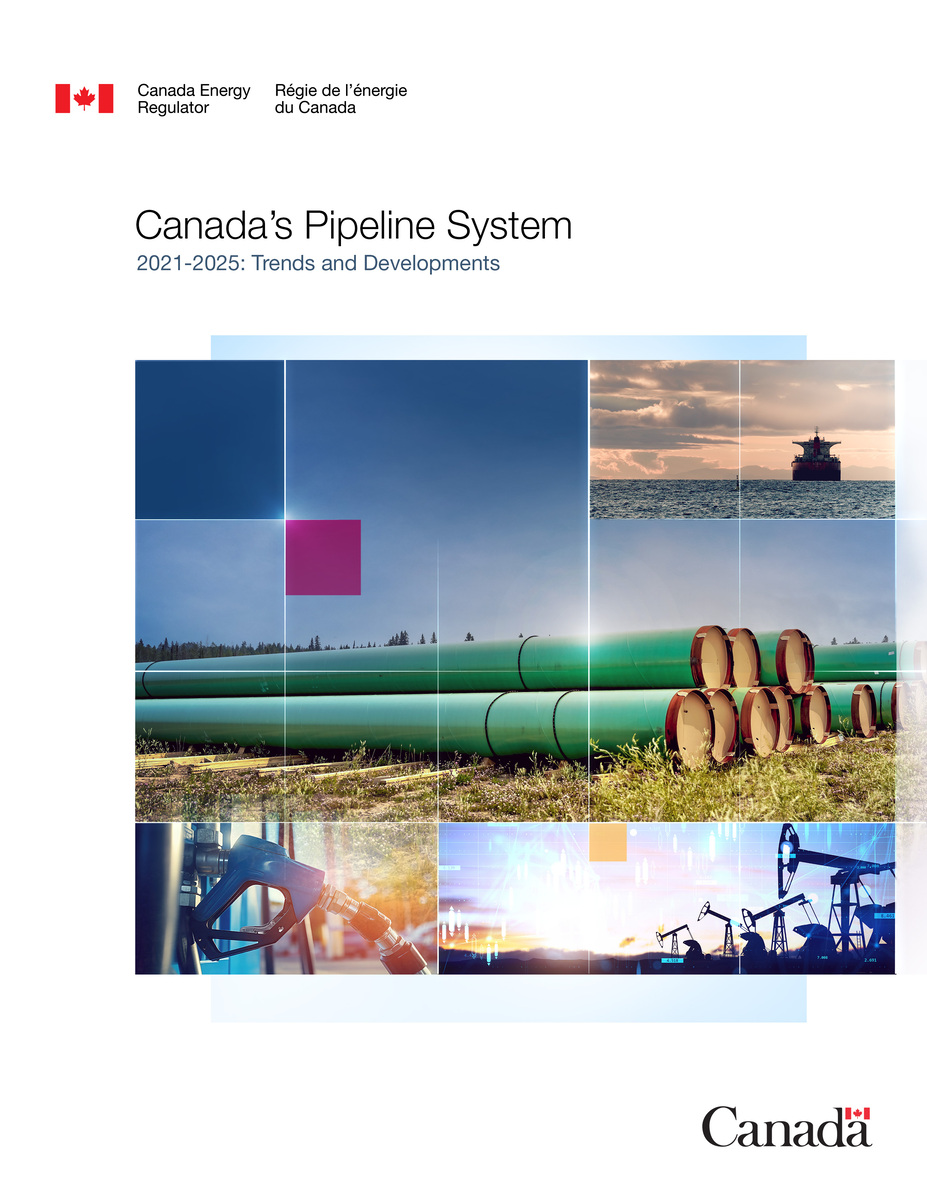
Canadians depend on pipelines to deliver crude oil, natural gas, natural gas liquids (NGLs), and refined petroleum products (RPPs) across Canada. These pipelines deliver energy safely to Canadians and enable international trade by connecting North American markets and by transporting energy to marine ports.
Pipelines that cross provincial boundaries or the Canada-U.S. border are federally regulated by the Canada Energy Regulator (CER). These pipelines may transport crude oil, liquids (such as natural gas liquids or refined petroleum products), natural gas, and other commodities (such as carbon dioxide or the pulp stock and white-water streams associated with pulp and paper manufacturing). The CER regulates over 73,000 kilometres (km) of pipeline, which is roughly 10% of all pipelines in Canada.Footnote 1 About 51,000 km (70%) are natural gas pipelines, 22,000 km (30%) are oil and liquids pipelines, and about 100 km transport other commodities.
CER-regulated pipelines are typically transmission pipelines, which carry large volumes of hydrocarbons over long distances to markets. Transmission pipelines are the focus of this publication, given their size and role in serving national and international markets. This publication assesses the status of these pipelines and the evolving contexts in which they operate.
This publication, Canada's Pipeline System, 2021–2025: Trends and Developments (Canada’s Pipeline System 2026), provides information on commodity markets, transportation trends, and economic regulation related to major CER-regulated interprovincial and international pipelines for the period from 2021 to 2025. Dedicated sections of the publication provide an overview of the major pipeline transportation systems for four groups of energy commodities:
These sections analyze recent trends in commodity markets, including Canadian supply and demand and Canada’s role in global markets. They also examine pipeline capacity and utilization, including recent expansions and proposed projects. Overviews of non-pipeline energy transportation modes, including rail and marine, are included in each section, where applicable, for additional context.
There is also a dedicated section of the publication on the CER’s Economic Regulation of pipelines, providing an overview of pipeline transportation tolls and tariffs, a summary of recent negotiated toll settlements and toll proceedings, and information on pipeline financial resource requirements and abandonment funding.
The final section on Financial Information for CER-regulated pipeline companies provides an overview of pipeline financial metrics, including deemed equity ratio, return on equity, rate base, and revenue. It also features information on recent investment decisions and corporate ownership changes.
The dashboards in this publication are interactive and web-based. The CER’s intent is to provide interactive and data-driven digital content. Figure data can be downloaded by clicking the ellipses in the top right-hand corner and selecting “Export Data.”
The publication does not make any determination on or assessment of projects that are, or may be, proposed before the Commission of the CER. The CER Commission is responsible for decisions and recommendations pursuant to its mandate set out in the Canadian Energy Regulator Act (CER Act)Footnote 2 and other legislation. The Commission makes such decisions and recommendations based on the evidence and submissions before it at that time. If a party wishes to rely on this publication in any regulatory proceeding before the Commission, it may submit the material in the same manner it would submit any public document and could be required to answer questions about it.
The data used in this publication comes from several sources:
More information about the CER’s regulated pipelines, including maps, environmental information, and pipeline safety, is available in the Pipeline Profiles.
Previous versions of this publication are available here:
This publication is provided pursuant to the CER’s mandate and responsibilities under the CER Act, which include advising and reporting on energy matters. Through its Energy Information core responsibility, the CER collects, monitors, analyzes, and publishes information on energy markets and supply, sources of energy, and the safety and security of pipelines and international power lines. The CER is committed to ensuring that Canadians can access and use energy information for knowledge, research, and decision-making, and have opportunities to collaborate and provide feedback on CER information products.
Canada Energy Regulator. (2026). Canada's Pipeline System, 2021–2025: Trends and Developments. https://www.cer-rec.gc.ca/en/data-analysis/facilities-we-regulate/canadas-pipeline-system/2026/
Email energy-energie@cer-rec.gc.ca
