Your feedback will help us improve and better meet your needs (opens in new tab)
Natural gas liquids (NGLs) are hydrocarbons extracted primarily from natural gas and, to a lesser extent, from crude oil refining and bitumen upgrading. They include ethane, propane, butane, pentanes plus, and condensate.
Figure 1: NGL system overviewFootnote 1
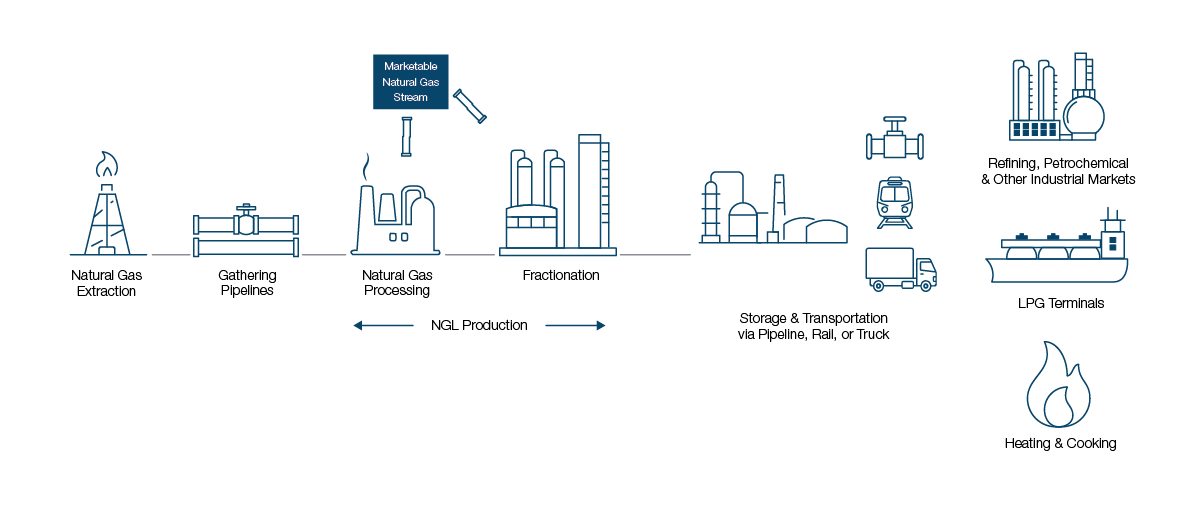
Source: CER
Text Alternative: This diagram illustrates the NGL value chain from natural gas production through processing, transportation, and final use. Natural gas production at the wellhead is transported via pipeline for processing. Most of the NGLs in natural gas are extracted at gas processing facilities, and some NGLs at larger fractionator facilities located on major natural gas pipelines in Alberta. Once produced, NGLs are transported via pipeline, rail or truck to markets. Propane and butane are also liquefied and transported to other international markets via marine vessels. Some NGLs can also be stored in pressurized tanks or underground.Footnote 2
NGLs are used across industrial, residential, commercial, and transportation markets. Ethane is mainly a petrochemical feedstock to create ethylene and plastics. Propane and butane are petrochemical feedstocks, as well as fuels for heating and cooking. The largest use of butane is for gasoline blending, and to a lesser extent for heavy oil blending. Condensate and pentanes plus behave like very light oils and, in Canada, are almost entirely used as diluent, where they are blended with heavy crude oils, such as oil sands bitumen so the heavy oils can be thinned and flow through pipelines or onto rail cars. Otherwise, in international markets, condensate and pentanes plus are primarily used as feedstocks to produce refined petroleum products (RPP) or petrochemicals. Together, NGLs play a key role in energy markets.
Table 1. NGLs descriptions
Ethane |
A hydrocarbon gas. | Fractionators/straddle plants. | Petrochemical feedstock, industrial. |
Propane |
Propane is a gas at room temperature and pressure, but condenses into a liquid when pressurized and/or cooled. | Gas plants, fractionators/ straddle plants, refineries, oil sands upgraders. | Heating, cooking, petrochemical, industrial. |
Butane |
Butane is a gas at room temperature and pressure, but condenses into a liquid when pressurized and/or cooled. | Gas plants, fractionators/ straddle plants, refineries, oil sands. | Fuel blending, diluentFootnote 3, petrochemicals, heating, cooking, industrial. |
Pentanes Plus |
Like a very light oil. | Gas plants, fractionators/straddle plants, refineries. | Diluent, RPP feedstock, petrochemical feedstock. |
Condensate |
Like a very light oil. | Produced at gas well sites. | Diluent, RPP feedstock, petrochemical feedstock. |
Source: CER
Text Alternative: This table details the definition, production process, applications, and end-use products.
NGLs in Canada are transported by pipeline, rail, truck, and marine vessels. Transportation types vary by product and end use. Ethane is transported exclusively by pipeline to petrochemical facilities. Propane and butane are transported multiple ways depending on the destination. Condensate and pentanes plus can move from the field to gas-processing plants and fractionators by pipeline, rail, and by truck, before moving to oil sands facilities by pipeline. Pipelines move large volumes between production areas and distribution hubs. Trucks primarily deliver propane to residential and commercial end users, while marine vessels transport propane and butane to international markets. Rail plays an important role in moving propane and butane between inland hubs and accessing markets beyond pipeline reach, as well as transporting propane and butane to the west coast LPG terminals.
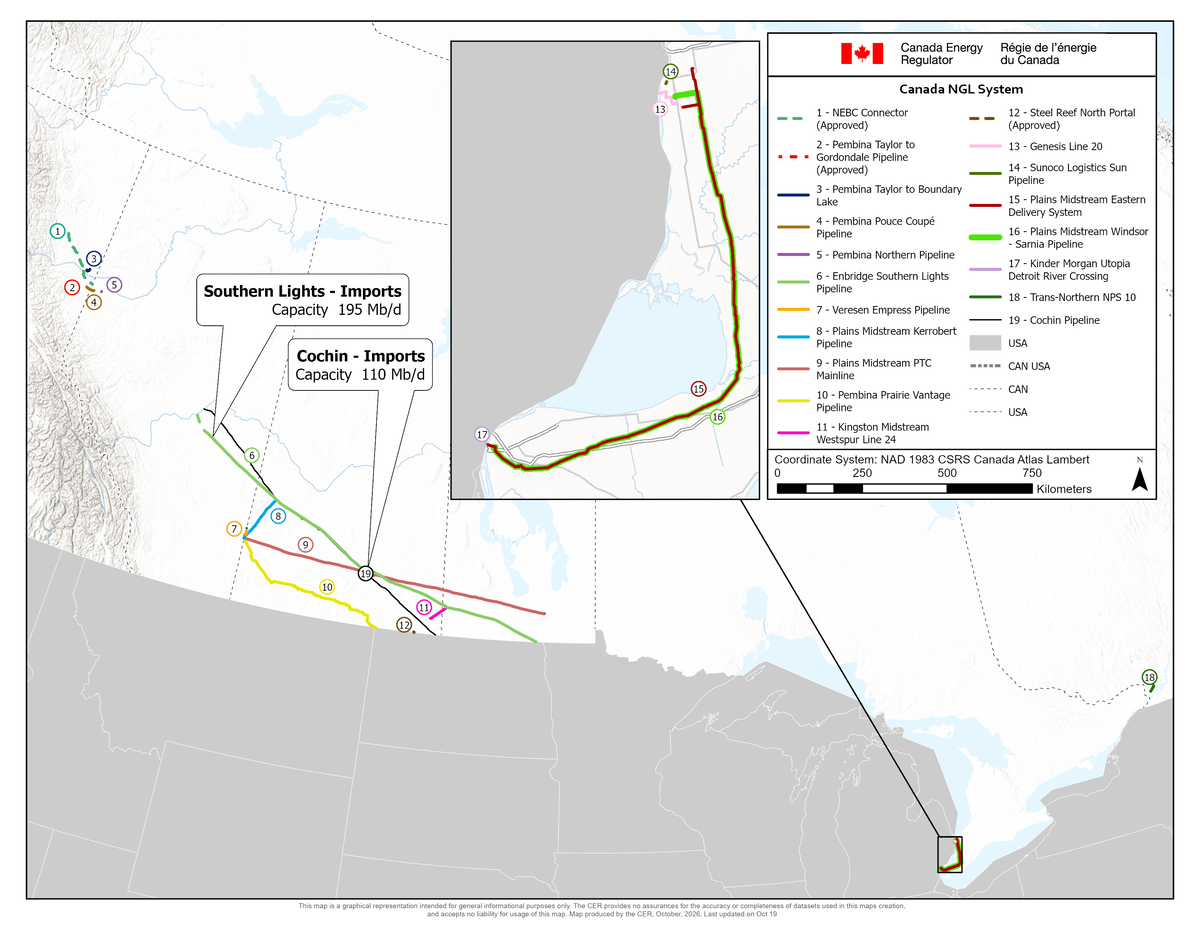
Canada’s NGL pipeline system consists of three main networks. Pipelines from northeastern British Columbia to Alberta transport mixed or pure NGLs for further processing and market distribution. In the Prairies, an interconnected system moves specific NGL products both west—east and east—west, including cross-border flows to and from the United States. A third network in southwestern Ontario supplies NGLs to petrochemical hubs, delivering feedstock from multiple sources to processing and manufacturing facilities.
Figure 2: CER-regulated NGL pipelines
Source: CER; Geomatics Data Management Inc. (GDM)
Text Alternative: This figure shows the CER-regulated pipelines that carry NGL, as well as NGL pipelines that are approved by the CER Commission. It also states the capacity of the import diluent pipelines: Southern Lights has a capacity of 195 Mb/d and Cochin has a capacity of 110 Mb/d.
Ethane is used by the petrochemical industry to make plastics. Ethane production in Canada only serves the domestic petrochemical industry in Alberta.Footnote 4 Ethane productionFootnote 5 in Canada has remained fairly flat because petrochemical ethane demand has remained fairly flat in western Canada, as have ethane imports from the U.S. Canada does not have dedicated ethane export pipelines. In 2025, Canada produced an estimated 250 Mb/d of ethane, increasing 14 per cent from 2021, with Alberta accounting for 98 per cent of production.Footnote 6 To meet its remaining demand, the Alberta petrochemical industry imported an annual average of around 30 Mb/d of ethane from the U.S. over the last five years.Footnote 7
Because ethane production is limited by petrochemical demand, potential excess ethane supply remains in the natural gas stream to be consumed for its heat value, like methane. Ethane not recovered – that is, ethane left in the natural gas stream – in 2025 is estimated to be 183 Mb/d, a two-fold increase from the amount of ethane not recovered in 2021. This is because liquids-rich natural gas production continued to grow in western Canada, while Alberta demand for ethane remained comparatively flat. In 2025, it is estimated that 44% of ethane potential supply was not recovered and was left in the natural gas stream.
Ethane demand is expected to significantly increase around 2029 with the development of a new petrochemical facility in Alberta. On 29 November 2023, Dow Canada announced a positive final investment decision for its Path2Zero project in Fort Saskatchewan, Alberta. Path2Zero is a net-zero emissions integrated ethylene cracker and derivatives facility that will require an estimated 120 Mb/d of ethane once operational. The facility will increase Dow’s polyethylene and ethylene derivatives production capacity by about 3 million metric tonnes per year. Construction is currently underway, with completion expected in 2029. This project will materially increase Canada’s ethane consumption. In Ontario, NOVA Chemicals completed the Corunna cracker expansion in late 2022. The project increased ethylene production capacity by more than 50%, enabling higher ethane feedstock use and supporting sustained imports into the province.
Figure 3: Ethane production
Source: Alberta Energy Regulator’s ST3 statistical report, Government of British Columbia’s Natural Gas & Oil Statistics, and Government of Saskatchewan’s Gas Plant Report
Text Alternative: This figure shows annual average ethane production by province from 2015 to 2025. Alberta’s ethane production remained relatively stable over the period. Production peaked around 2016 at 241 Mb/d, declined to a low in 2021 of 213 Mb/d, and has since recovered steadily through 2025, reaching 245 Mb/d in 2025. British Columbia ethane production has been under 20 Mb/d and Saskatchewan has minimal ethane production.
Ethane transportation in Canada is almost entirely pipeline-based and is designed to deliver consistent, high-purity feedstock directly to petrochemical facilities in Alberta and Ontario. Unlike other natural gas liquids, ethane is not typically moved by rail or truck, making dedicated pipeline systems important for connecting both production and import volumes with downstream demand. In addition to the ethane produced domestically, Canada imports ethane from the United States by pipeline into Saskatchewan (for use in Alberta) and southwestern Ontario.
In Alberta, domestically recovered ethane from gas processing plants is transported through the Alberta Ethane Gathering System (AEGS), a dedicated provincially regulated network with a capacity of 330 Mb/d. The system aggregates ethane from extraction facilities and delivers product directly to petrochemical plants near Fort Saskatchewan and the Edmonton region.
To supplement domestic recovery and ensure uninterrupted supply for downstream users, additional ethane volumes are imported through the CER-regulated Vantage Pipeline. This pipeline transports ethane from North Dakota into Alberta, where it interconnects with the AEGS. Vantage has capacity of roughly 68 Mb/d, providing a source of incremental supply and operational flexibility. By pooling imported and domestic volumes within the same network, Alberta’s system can maintain steady deliveries even when upstream recovery varies due to processing economics or maintenance. This integration reduces supply risk for petrochemical facilities that require continuous feedstock.
In Central Canada, ethane delivery is similarly supported by dedicated import infrastructure serving the petrochemical corridor near Sarnia. The Utopia Pipeline transports ethane from the United States shale basins into Ontario. With limited local ethane production, this pipeline supplies the majority of feedstock for regional processing and provides a direct connection to U.S. supply. As a result, Ontario’s petrochemical operations are closely tied to cross-border pipeline access rather than domestic gathering systems.
Propane and butane production in Canada is highly concentrated in Alberta and northeastern British Columbia, sourced from liquids-rich natural gas production from the Montney Formation, Duvernay Shale, and other tight formations. Most propane and butane production in Canada is produced from gas-processing facilities in B.C., Alberta, and OntarioFootnote 8, with the bulk in Alberta. Smaller volumes are produced at oil refineries and bitumen upgraders as by-products of crude oil refining and upgrading processes. Increasing liquids-rich natural gas production in western Canada has led to propane and butane production growth that has outpaced domestic consumption, leading to more supply available for export to international markets.
In 2025, Canada produced 566 Mb/d of propane and butane, up 21% from 469 Mb/d in 2021, with propane’s share of production at 62% in 2025. Domestic consumption of propane and butane is driven primarily by residential and commercial heating demand, petrochemical feedstock use, and butane-gasoline blending. Canadian propane and butane demand was 238 Mb/d in 2025, increasing less than one percent from 2021 to 2025.
Figure 4: Propane and butane production
Source: Alberta Energy Regulator’s ST3 statistical report, Government of British Columbia’s Natural Gas & Oil Statistics, and Government of Saskatchewan’s Gas Plant Report, and CER estimate of flows on Enbridge
Text Alternative: This figure shows annual average propane and butane production by province from 2015 to 2025. It also includes an estimate of annual average propane and butane transported on the Enbridge Mainline. Canadian propane and butane production has increased steadily over the 2015–2025 period, rising from 279 Mb/d in 2015 (176 Mb/d propane and 103 Mb/d butane) to 566 Mb/d in 2025 (352 Mb/d propane and 214 Mb/d butane), doubling over the decade. Growth was particularly strong between 2017 and 2019, when total production increased from 352 Mb/d to 447 Mb/d. Since 2020, production has trended upward, reaching its highest level in 2025. Propane consistently accounts for a substantial share of production. Alberta consistently has the most propane and butane production. In 2025, Alberta produced 228 Mb/d of propane and 141 Mb/d of butane.
Western Canadian propane and butane production is transported to domestic and export markets through a combination of rail, pipeline, truck, and marine infrastructure. In particular, rail connects LPG supply in northeast British Columbia and in Alberta to British Columbia’s west coast, where LPG is exported by marine vessel. Figure 5 shows the distribution of Canadian propane and butane exports by transportation mode.
Figure 5: Propane and butane exports by transportation mode
Source: CER, Natural Gas Liquids - Exports
Text Alternative: Canadian propane and butane exports by transportation mode show clear divergence over time. Since 2010 rail transported the most, rising from 63 Mb/d in 2010 to a peak of 191 Mb/d in 2019, then remaining somewhat level after 2020, reaching 162 Mb/d in 2025. Marine LPG exports started in 2019, averaging 22 Mb/d in 2019 and increasing to 89 Mb/d in 2024 and 80 Mb/d in 2025. Pipeline volumes declined from 32 Mb/d in 2010 to 14-22 Mb/d in recent years, while truck volumes remain relatively low and stable, fluctuating between 5–13 Mb/d since 2010.
Rail transportation
Rail remains the most used transportation mode for Canadian propane and butane exports, particularly from western Canada where liquids-rich natural gas processing generates large volumes of NGLs. Rail shipments typically increase during the winter heating season, when propane demand rises, and decline during the summer months.
Propane and butane are transported in pressurized rail tank cars and shipped from western Canada:
Rail transportation of propane and butane averaged 162 Mb/d in 2025, hovering around that level since 2020. Rail volumes reached a peak of 191 Mb/d in 2019. Rail infrastructure plays an important role in supplying both U.S. markets and Canadian marine LPG export terminals. In central Canada, Sarnia functions as a key inland distribution hub where rail deliveries supplement local refinery and fractionation output. From this hub, propane and butane are primarily redistributed to end-use markets by truck or short-haul rail, as pipeline takeaway options downstream of Sarnia are limited for LPG movement.
Marine transportation
Marine transportation provides Canadian propane and butane access to overseas markets. On the West Coast, propane is transported by rail to marine LPG export terminals where it is transferred to vessels for shipment to international destinations, primarily in Asia. Canada exported 80 Mb/d via marine terminals in 2025, doubling 2020 volumes.
In 2019, Canada’s first propane export terminal, AltaGas’s Ridley Island Propane Export Terminal, began exporting liquefied propaneFootnote 10 to Asia. AltaGas’s terminal was constructed with an export capacity of 40 Mb/d and was operating near capacity in 2020. Through higher efficiency, optimizing on-site facilities and rail-related logistics, AltaGas doubled its export capacity to 80 Mb/d in August 2020. The CER approved AltaGas’s application for increased exports in August 2020.Footnote 11
A second propane export terminal, Pembina Pipeline’s Prince Rupert Terminal, commenced exports in April 2021, with a capacity of 25 Mb/d. Additional capacity is being developed and proposed, notably the Ridley Island Energy Export Facility (REEF – a joint venture between AltaGas and Royal Vopak),Footnote 12 a bulk liquids terminal, including propane, on Ridley Island near Prince Rupert, B.C. Other proposed terminals have been discussed for the north coast of B.C., though details and proponents vary.
These export terminals provide western Canadian propane producers with access to markets in Asia, and Central and South America. All existing and proposed export terminals on Canada’s west coast will receive their feedstock by rail.
Figure 6: Canadian NGL exports by destination
Source: Canada Energy Regulator Propane and Butanes Export Summary
Text Alternative: Canadian propane and butane exports mostly go to the United States, with United States volumes increasing from about 100 Mb/d in 2010 to roughly 189 Mb/d in 2025. Smaller volumes to Mexico, Japan, and South Korea emerge after 2017, reaching around 74 Mb/d to Japan in 2025. Exports to China appear more recently, rising to approximately 6 Mb/d in 2025, while Singapore remains minimal throughout.
Marine export infrastructure provides Canadian LPG producers with direct access to international markets and supports the diversification of export destinations beyond the United States.
Pipeline transportation
Pipeline infrastructure primarily supports cross-border movements of propane, butane, and other natural gas liquids between Canada and the United States. Pipeline infrastructure therefore plays an important role in supplying U.S. regional markets with Canadian propane and butane.
In western and central Canada, the Enbridge Canadian Mainline system transports light crude oil, refined petroleum products, and a mix of NGLs from Edmonton, Alberta, to Sarnia, Ontario, and U.S. Midwest markets. Depropanizer facilities located in Superior, Wisconsin, and Rapid River, Michigan, remove propane from the mixed NGL stream before the remaining liquids continue to Sarnia for fractionation into specification products. Line 1 of the Enbridge Canadian Mainline has a capacity of 237 Mb/d, while Line 5 has a capacity of 540 Mb/d. However, it is important to note that NGLs make up a relatively small share of Line 5’s overall volumes as it mostly transports crude oil. Fractionated NGL products are subsequently delivered to markets in central and eastern Canada and the U.S. Midwest.
Additional pipeline infrastructure in southwestern Ontario supports propane and butane exports to the United States. Plains Midstream Canada’s Eastern Delivery System (EDS), which operates between Sarnia and Windsor, has a capacity of 150 Mb/d and provides an important connection for cross-border LPG trade. Other regional pipelines transport ethane and mixed NGL streams associated with the broader liquids market. Kinder Morgan’s Utopia Pipeline delivers ethane sourced from the Utica Shale and an ethane-propane mix from Harrison County, Ohio, to Windsor, Ontario. From Windsor, Plains’ Windsor–Sarnia Pipeline transports ethane feedstock to NOVA’s petrochemical facilities in Corunna, Ontario, and storage facilities in Sarnia. The Utopia Pipeline repurposed part of the former Cochin Pipeline and entered service in 2018.
The Genesis Pipeline, with a capacity of 37 Mb/d, also supplies ethane to the Sarnia petrochemical complex. The pipeline originates near Marysville, Michigan, crosses the St. Clair River into Canada, and delivers ethane transported from the Marcellus region via the Mariner East Pipeline System.
Canadian propane and butane exports are primarily directed to the United States, where established pipeline and rail networks connect western Canadian supply with key regional markets. Demand for Canadian LPG is strongest in U.S. regions that experience seasonal heating demand or have limited local supply. As a result, a large share of exports is delivered to the U.S. East Coast, Midwest, and West Coast markets. Figure 7 shows the distribution of Canadian propane and butane exports to U.S. Petroleum Administration for Defense Districts (PADDs) and other destinations between 2010 and 2025. Over this period, exports remained relatively stable before reaching a peak in 2019, followed by a stabilization period after the COVID-19 pandemic in 2020.
As illustrated in Figure 7, PADD I, PADD II, and PADD V (respectively, the U.S. East Coast, Midwest, and West Coast) remain important destinations for Canadian propane and butane exports. These markets benefit from established pipeline and rail connectivity, supply deficits in certain coastal regions, and strong seasonal heating demand, which together provide consistent export opportunities for Canadian supply. In contrast, PADD III and PADD IV (respectively, the U.S. Gulf Coast and Rocky Mountain regions) receive relatively small volumes of Canadian propane and butane. These regions have significant domestic NGL production, particularly from the Permian Basin and other U.S. shale plays, which reduces the need for Canadian imports.
Figure 7: Propane and butane exports by U.S. PADD
Source: CER, Natural Gas Liquids - Exports
Text Alternative: Canadian propane and butane exports by destination used to be led by PADD II, which increased from 52 Mb/d in 2010 to a peak of 63 Mb/d in 2018, before declining to 58 Mb/d in 2025. PADD III and PADD IV see smaller volumes. PADD I volumes have been fairly steady – going from 33 Mb/d in 2010 to 36 Mb/d in 2025. In contrast, PADD V has grown significantly, increasing from 14 Mb/d in 2010 to 73 Mb/d in 2025, making it the largest destination in recent years.
Domestic production of condensate and pentanes plus has increased as liquids-rich natural gas production increased in the Montney and Duvernay Formations. Canadian condensate and pentanes plus production has increased steadily over the past five years, rising from 391 Mb/d in 2021 to 469 Mb/d in 2025, representing a 20% increase.Footnote 13 Growth was strongest between 2016 and 2019, reflecting growing oil sands production and associated demand for diluent. Production declined slightly in 2020, consistent with broader market disruptions from the COVID-19 Pandemic, before resuming a mostly upward trend through to 2025. Alberta accounts for most condensate and pentanes plus production, while British Columbia contributes a smaller but steadily growing shareFootnote 14 and Saskatchewan production remains minimal.
The growth in production is particularly significant for Canadian crude oil markets. Pentanes plus and condensate are commonly used as diluent blended into bitumen and heavy crude oil, allowing these heavier products to meet pipeline viscosity specifications. Oil sands production continues to grow and drives strong diluent (condensate and pentanes plus) demand.
Diluent is more than just pentanes plus and condensate. Naphtha is produced at refineries from the lightest parts of crude oil and is also used to dilute heavy oil. Chemically, pentanes plus, condensate and naphtha are nearly identical, just named differently based on their origin: condensate at well sites, pentanes plus at gas-processing plants, and naphtha at refineries.Footnote 15
Figure 8: Condensate and pentanes plus production
Source: Alberta Energy Regulator’s ST3 statistical report, Government of British Columbia’s Natural Gas & Oil Statistics, and Government of Saskatchewan’s Gas Plant Report, and CER estimate of flows on Enbridge
Text Alternative: This figure shows annual average condensate and pentanes plus production by province from 2015 to 2025. It also includes an estimate of annual average pentanes plus transported on the Enbridge Mainline. Canadian condensate and pentanes plus production increased steadily over the past decade, rising from 202 Mb/d in 2015 to 469 Mb/d in 2025. Alberta accounts for most of this production and drives overall trends. British Columbia contributes a smaller but gradually increasing share, while Saskatchewan production and estimated flows on Enbridge remain minimal.
Canada’s bitumen productionFootnote 16 and heavy oil production require about 30% diluent blending by volume, meaning diluent demand grows proportionally with bitumen production.Footnote 17 Domestic diluent production remains lower than demand; therefore, oil sands producers continue to rely on imports to fill the gap, with about half of diluent demand in 2025 being met by imports from the United States. The two CER-regulated diluent import pipelines are Enbridge’s Southern Lights Pipeline and Pembina’s Cochin Pipeline.
Diluent intra and inter-province pipeline network
Western Canadian domestic condensate and pentanes plus production is transported to market through an extensive intra- and interprovincial pipeline network centred on the Edmonton and Fort Saskatchewan hubs. Existing provincial pipeline systems, such as Pembina Pipeline’s Peace Pipeline, Pouce Coupe System, and the Northern System gather condensate and other NGLs from liquids-rich gas production in northeastern British Columbia and west-central Alberta. They then deliver these products to Edmonton and Fort Saskatchewan hubs. Since the existing networks are near operating capacity, this network is being expanded through new and proposed infrastructure.
Table 2. Recent and proposed pipelines and expansions
| System Name | Company (Parent Company) | Commodity | Capacity | Status | Regulator |
|---|---|---|---|---|---|
| NEBC Connector | NorthRiver Midstream NEBC Connector GP Inc. (NorthRiver Midstream) | Condensate + NGL mix | 91 Mb/d
|
Under construction | Canada Energy Regulator |
| Pouce Coupe Taylor to Gordondale | Pouce Coupé Pipe Line Ltd. (Pembina Pipeline Corporation) | Condensate | 118 Mb/d
|
Received GIC approval February 2026. | Canada Energy Regulator |
| Southern Lights Line 13 Expansion | Enbridge Southern Lights GP Inc. on behalf of Enbridge Southern Lights LP (Enbridge Inc.) | Condensate | 15 Mb/d (total capacity to 198 Mb/d)
|
Completed in 2025 | Canada Energy Regulator |
| Southern Lights Line 13 Expansion – Variance Request | Enbridge Southern Lights GP Inc. on behalf of Enbridge Southern Lights LP (Enbridge Inc.) | Condensate | Incremental capacity increase to bring total project capacity up to 240 Mb/d | Order to vary issued by the Commission of the CER on 4 May 2026 | Canada Energy Regulator |
| Key Access Pipeline System (KAPS) | Keyera Corp. | Condensate + NGL mix | 350 Mb/d
|
Completed in 2023 | Alberta Energy Regulator |
| KAPS Zone 4 Expansion | Keyera Corp. | Condensate + NGL mix | N/A (extension of KAPS) | Under construction | Alberta Energy Regulator |
Condensate and pentanes plus import pipelines
Enbridge Southern Lights Pipeline
The Southern Lights Pipeline transports diluent from Manhattan, Illinois to Edmonton, Alberta. In Edmonton, the Southern Lights Pipeline is directly connected to several provincially regulated pipelines that ship diluent to oil sands facilities. It is also directly connected to the Enbridge Mainline in both Alberta and Saskatchewan.
Over the past several years, diluent volumes transported on the Southern Lights system have generally increased. Total volumes rose from 133 Mb/d in 2021 to 176 Mb/d in 2025, an increase of 32 per cent, driven primarily by growth in committed shipper volumes. Committed volumes increased from 127 Mb/d in 2021 to 162 Mb/d in 2025, an increase of roughly 28%. Reflecting continued growth in diluent demand and high utilization of the pipeline, Enbridge commissioned an additional 15,000 b/d of capacity on the Southern Lights Pipeline in 2025 through terminal and station modifications, bringing total capacity to 198 Mb/d. In March 2026, Enbridge applied to vary the Order of the expansion to a capacity of 240 Mb/d. On 4 May 2026, the relief was granted.
Figure 9: Southern Lights throughput, capacity, and utilization
Source: CER, Pipeline Throughput and Capacity Data; Geomatics Data Management Inc. (GDM), Esri, TomTom, Garmin, FAO, NOAA, USGS, ©OpenStreetMap contributors, and the GIS User Community
Text Alternative: Southern Lights Pipeline quarterly throughput fluctuated between roughly 110 and 190 Mb/d from 2021 to 2025, while capacity increased from 180 Mb/d to 198 Mb/d in June 2025. As a result, utilization remained moderate and well below full capacity, indicating available spare capacity throughout the period
Cochin Pipeline
The Cochin pipeline receives diluent primarily from Explorer, TEPPCO, and Wasbash pipelines at a terminal in Kankakee, Illinois, and transports it to several third-party terminals and pipelines near Fort Saskatchewan, Alberta. These facilities store and transport the condensate to the oil sands and other heavy oil production sites in Alberta. Condensate throughput on Cochin at Fort Saskatchewan increased between 2021 and 2023, before declining slightly over the following two years.
Average throughputs rose from 84 Mb/d in 2020 to 102 Mb/d in 2022, reflecting a continued increase in condensate imports into Western Canada. Throughputs stayed relatively steady and operated close to the 110 Mb/d capacity for the next two years. They declined slightly to 95 Mb/d in 2025, largely because of a dip in September 2025 caused by narrower Canada-U.S. condensate price differentials and lower spot volumes.Footnote 18 Combined throughput on Southern Lights and Cochin, both with 90% committed volumes, suggests that total diluent imports are robust and increasing.
Figure 10: Cochin throughput, capacity, and utilization
Source: CER, Pipeline Throughput and Capacity Data; Geomatics Data Management Inc. (GDM), Esri, TomTom, Garmin, FAO, NOAA, USGS, ©OpenStreetMap contributors, and the GIS User Community
Text Alternative: Cochin pipeline throughput generally ranged between about 58 and 118 Mb/d from 2021 to 2025, closely tracking its capacity of approximately 110 Mb/d and indicating relatively high utilization over most of the period. Throughput became more volatile in 2024 and 2025, with occasional peaks above capacity and a sharp decline in 2025.