
Provincial and Territorial Energy Profiles – New Brunswick
Update in progress
An update to these profiles will launch in Summer 2024. For current data and information, please visit:
- Canada's Energy Future data appendices tool
- Environment and Climate Change Canada's GHG Emissions Inventory

Connect/Contact Us
Please send comments, questions, or suggestions to
energy-energie@cer-rec.gc.ca
Table of Contents
-
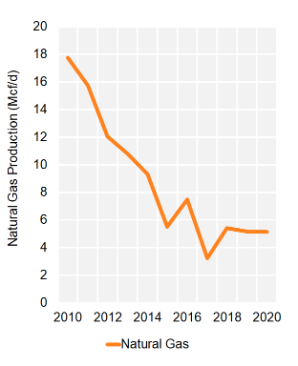
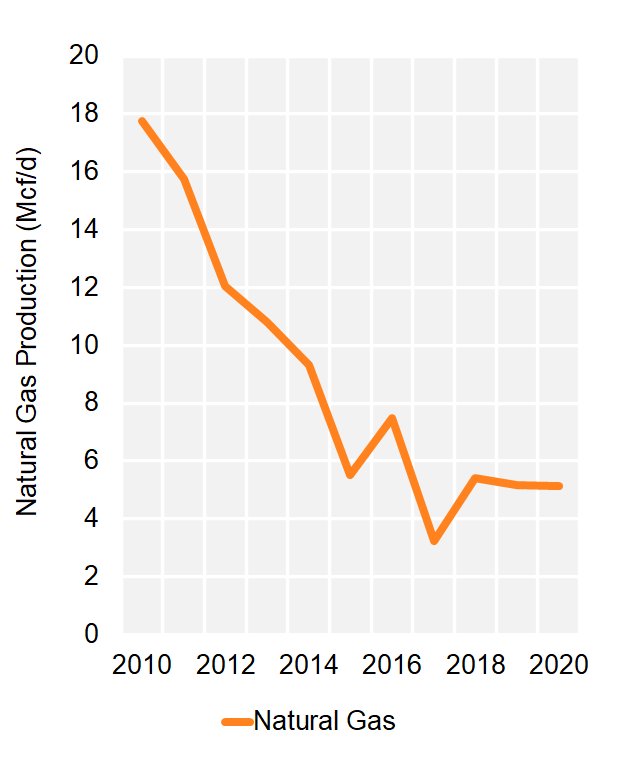
Figure 1: Hydrocarbon Production
Source and Description:
Source:
CER – Canada's Energy Future 2021 Data AppendicesDescription:
This graph shows hydrocarbon production in New Brunswick from 2010 to 2020. Natural gas production decreased from 17.8 MMcf/d to 5.1 Mmcf/d. -
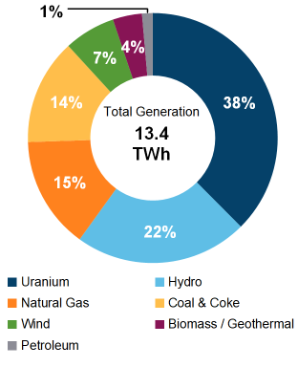
Figure 2: Electricity Production (2019)
Source and Description:
Source:
CER – Canada's Energy Future 2021 Data AppendicesDescription:
This pie chart shows electricity generation by source in New Brunswick. A total of 13.4 TW.h of electricity was generated in 2019. -
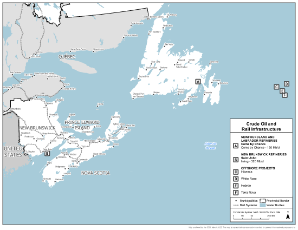
Figure 3: Crude Oil Infrastructure Map
Source and Description:
Source:
CERDescription:
This map shows all rail lines and refineries in New Brunswick, and crude oil infrastructure in Atlantic Canada.Download:
PDF version [1 156 KB] -
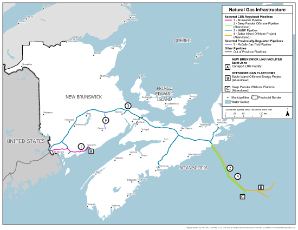
Figure 4: Natural Gas Infrastructure Map
Source and Description:
Source:
CERDescription:
This map shows all major natural gas pipelines,offshore natural gas platforms, and the Canaport LNG terminal in the Maritimes.Download:
PDF version [877 KB] -
Figure 5: End-Use Demand by Sector (2019)
Source and Description:
Source:
CER – Canada's Energy Future 2021 Data AppendicesDescription:
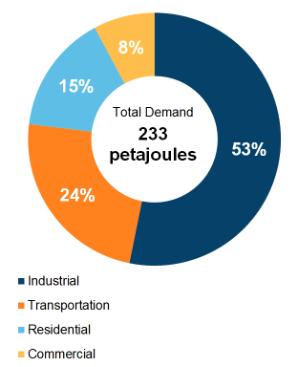
This pie chart shows end-use energy demand in New Brunswick by sector. Total end-use energy demand was 233 PJ in 2018. The largest sector was industrial at 53% of total demand, followed by transportation (at 24%), residential (at 15%), and lastly, commercial (at 8%). -
Figure 6: End-Use Demand by Fuel (2019)
Source and Description:
Source:
CER – Canada's Energy Future 2021 Data AppendicesDescription:
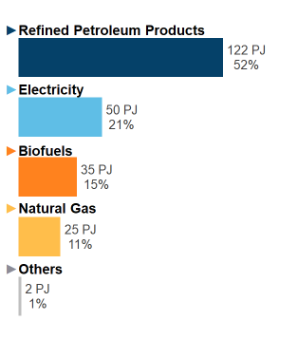
This figure shows end-use demand by fuel type in New Brunswick in 2018. Refined petroleum products accounted for 122 PJ (52%) of demand, followed by electricity at 50 PJ (21%), biofuels at 35 PJ (15%), natural gas at 25 PJ (11%), and other at 2 PJ (less than 1%).
Note: "Other" includes coal, coke, and coke oven gas. -
Figure 7: GHG Emissions by Sector
Source and Description:
Source:
Environment and Climate Change Canada – National Inventory ReportDescription:
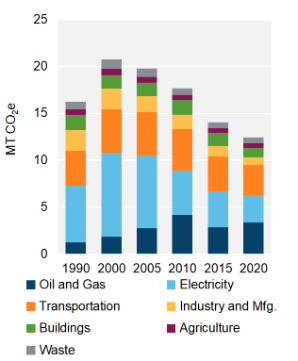
This stacked column graph shows GHG emissions in New Brunswick by sector every five years from 1990 to 2020 in MT of CO2 equivalent. Total GHG emissions have decreased in New Brunswick from 16.2 MT of CO2e in 1990 to 12.4 MT of CO2e in 2020. -
Figure 8: Emissions Intensity of Electricity Generation
Source and Description:
Source:
Environment and Climate Change Canada – National Inventory ReportDescription:
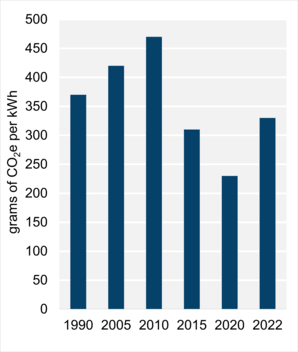
This column graph shows the emissions intensity of electricity generation in New Brunswick from 1990 to 2020. In 1990, electricity generated in New Brunswick emitted 370 g of CO2e per kWh. By 2020, emissions intensity decreased to 290 g of CO2e per kWh.


Energy Production
Crude Oil
- New Brunswick does not have any commercial crude oil production.
Refined Petroleum Products (RPPs)
- New Brunswick is a net producer of RPPs and a significant supplier of gasoline to the United States (U.S.) East Coast.
- The Irving Oil Refinery in Saint John is the only refinery in New Brunswick and it is the largest refinery in Canada. With a capacity of 320 thousand barrels per day (Mb/d), it produces RPPs in excess of New Brunswick’s needs. It operates primarily for exports to the U.S. and neighbouring provinces.
Natural Gas/Natural Gas Liquids (NGLs)
- In 2020, natural gas production in New Brunswick averaged 5.4 million cubic feet per day (MMcf/d) (Figure 1). This represented less than 0.1% of total Canadian natural gas production in 2020.
- Natural gas is produced from the McCully Field, near Sussex. The McCully Field was discovered in 2000 by a joint venture between Corridor Resources and Potash Corporation of Saskatchewan, and a total of 39 wells have been drilled to date. To optimize production with peak winter pricing, McCully Field shut-in production during the summer months beginning in 2017.
- Since 2014, a moratorium on hydraulic fracturing has been in place in New Brunswick.
- There is no field production of NGLs in New Brunswick. Small volumes of propane and butane are produced by the Irving Oil Refinery.
Electricity
- In 2019, New Brunswick generated 13.4 terawatt-hours (TWh) of electricity (Figure 2), which is approximately 2% of total Canadian generation. New Brunswick has an estimated generating capacity of 4 520 megawatts (MW).
- In 2019, approximately 38% of New Brunswick’s electricity generation was from nuclear, 30% was from fossil fuels (natural gas, coal, and petroleum), and 22% was from hydroelectricity. The remainder was produced from wind and biomass.
- New Brunswick Power Corporation (NB Power) generates most of the electricity in the province. NB Power operates a total of 13 hydro, coal, oil, and diesel-powered stations with a combined capacity of 3 130 MW. NB Power also operates the Point Lepreau Nuclear Generating Station. Point Lepreau is located near the Bay of Fundy and has a gross capacity of 705 MW.
- Independent power producers operate wind, biomass, natural gas, hydro, and other renewable energy facilities.
- Generation from wind power increased from none in 2005 to almost 7% of total generation in 2019. Biomass facilities provided 4% of generation.
Energy Transportation and Trade
Crude Oil and Liquids
- There are no crude oil pipelines in New Brunswick. All of New Brunswick’s crude oil supplies arrive by sea or rail. The majority of crude oil used by the refinery comes from non-Canadian sources. Canadian sources include offshore Newfoundland and Labrador by tanker and western Canada by rail.
- The Irving Oil Refinery receives most of its crude oil supply from Irving’s Canaport Marine Terminal, which can receive ultra-large crude carriers (ULCC) and has an oil storage capacity of six million barrels. The terminal can also receive and ship RPPs (Figure 3).
- The Irving Oil rail terminal has an estimated unloading capacity of 200 Mb/d.
- In July 2020, a tanker loaded with an estimated 450 000 barrels of crude oil at the Westridge Marine Terminal in Burnaby, British Columbia, unloaded at Irving Oil’s Canaport terminal. The crude oil was delivered to Westridge via the Trans Mountain Pipeline. The ship’s 12 000 kilometer (km) itinerary through the Panama Canal was the first time that crude oil from Alberta was delivered by ship to another refinery in Canada.
Natural Gas
- Natural gas is transported to/from New Brunswick via the Maritimes & Northeast Pipeline (M&NP), which extends from Goldboro, Nova Scotia, to an import/export point on the border with Maine near St. Stephen, New Brunswick (Figure 4). M&NP has not exported gas since 2016. In 2020, it imported 0.16 Bcf/d.
- The Maritimes is almost entirely reliant on natural gas imported from the U.S., as well as liquefied natural gas (LNG) delivered to the Canaport LNG import terminal in Saint John.
- Liberty Utilities, formerly Enbridge Gas New Brunswick, distributes natural gas to over 12 000 customers in 12 communities throughout southern New Brunswick. Liberty Utilities is regulated by New Brunswick Energy and Utilities Board and has about 1 200 km of natural gas distribution pipelines throughout the province.
- Re-gasified LNG from the Canaport LNG terminal is transported to the U.S. Northeast on the Emera Brunswick Pipeline, which extends from the Saint John area to the St. Stephen export point. The Emera Brunswick Pipeline transported an average of 70 MMcf/d in 2020, with flows being relatively stable over the past few years. The pipeline, with a capacity of 820 MMcf/d, remains underutilized.
Liquefied Natural Gas (LNG)
- New Brunswick is home to Canada’s only large-scale LNG import terminal. The Canaport LNG terminal began operating in 2009. In 2020, import volumes averaged 84.3 MMcf/d, far below Canaport’s send out capacity of 1 200 MMcf/d. The terminal now primarily imports LNG for peak winter demand.
- Canaport LNG was initially a partnership between Repsol, with a 75% stake, and Irving Oil, with the remaining 25% stake. In August 2021, Irving Oil sold its stake to Repsol.
Electricity
- New Brunswick exports electricity to Prince Edward Island (PEI) via two sub-sea cables, and it also exports to Maine. New Brunswick imports from Quebec and Maine. In 2020, Hydro-Québec and NB Power signed a power purchase agreement for Quebec to deliver a total of 47 TWh of electricity to New Brunswick between now and 2040. These imports will be transmitted over existing interconnections.
- In 2019, New Brunswick had 0.6 TWh of net interprovincial and international electricity inflows.
- NB Power operates the transmission system and acts as the system operator in the province, operating approximately 6 900 km of power lines in New Brunswick. NB Power also oversees 15 interconnections with an import capacity of 2 378 MW and an export capacity of 2 538 MW. These interconnections are with Maine, Quebec, Nova Scotia, and PEI.
Energy Consumption and Greenhouse Gas (GHG) Emissions
Total Energy Consumption
- End-use demand in New Brunswick was 235 petajoules (PJ) in 2019. The largest sector for energy demand was industrial at 55% of total demand, followed by transportation at 23%, residential at 14%, and commercial at 8% (Figure 5). New Brunswick’s total energy demand was the eighth largest in Canada, and the fifth largest on a per capita basis.
- RPPs were the largest fuel type consumed in New Brunswick, accounting for 119 PJ, or 51% of total energy consumption. Electricity and biofuels accounted for 49 PJ (21%) and 33 PJ (14%), respectively (Figure 6).
Refined Petroleum Products
- New Brunswick’s motor gasoline demand in 2019 was 1 364 litres per capita, 8% above the national average of 1 268 litres per capita.
- New Brunswick’s diesel demand in 2019 was 602 litres per capita, 30% below the national average of 855 litres per capita.
- RPP prices in New Brunswick have been regulated by the New Brunswick Energy and Utilities Board since 2006. Maximum prices at the retail level for gasoline, diesel, furnace oil, and propane are set on a weekly basis (or as required).
Natural Gas
- In 2020, New Brunswick consumed an average of 40.2 MMcf/d of natural gas, which represented less than 1% of total Canadian demand.
- New Brunswick’s largest consuming sector for natural gas was the industrial sector, which consumed 31.6 MMcf/d in 2020. The commercial and residential sectors consumed 7.1 MMcf/d and 1.5 MMcf/d, respectively.
Electricity
- In 2019, annual electricity consumption per capita in New Brunswick was 17.6 megawatt-hours (MWh). New Brunswick ranked fourth in Canada for per capita electricity consumption and consumed 18% more than the national average.
- New Brunswick’s largest consuming sector for electricity in 2019 was residential (5.6 TWh). The industrial and commercial sectors consumed 4.9 TWh and 3.1 TWh, respectively.
- Electricity demand is highest in the winter because of space heating requirements for homes and businesses. Demand is lower during the warmer months, and surplus electricity is exported to neighbouring provinces and states.
GHG Emissions
- New Brunswick’s GHG emissions in 2020 were 12.4 megatonnes (MT) of carbon dioxide equivalent (CO2e).Footnote 1 New Brunswick’s emissions have declined 23% since 1990 and 37% since 2005.
- New Brunswick’s emissions per capita are 15.9 tonnes CO2e – 10% below the Canadian average of 17.7 tonnes per capita.
- The largest emitting sectors in New Brunswick are oil and gas (primarily petroleum refining) at 27% of emissions, transportation at 26%, and electricity generation at 23% (Figure 7).
- New Brunswick GHG emissions from the oil and gas sector in 2020 were 3.4 MT CO2e. Of this total, 3.3 MT were attributable to petroleum refining, and 0.1 MT were attributable to production, processing, and transmission.
- In 2020, New Brunswick’s power sector emitted 2.9 MT CO2e emissions, which represents about 5% of Canada’s GHG emissions from power generation. Through a renewable portfolio standard, the province of New Brunswick aimed to increase renewables’ share of electricity serving in-province sales to 40% in 2020. In the 2020-2021 fiscal year, 51% of power sold in the province came from renewable sources.
- The greenhouse gas intensity of New Brunswick’s electricity grid, measured as the GHGs emitted in the generation of the province’s electric power, was 290 grams of CO2e per kilowatt-hour (g of CO2e/kWh) in 2020. This is a 28% reduction from the province’s 2005 level of 400 g of CO2e/kWh. The national average in 2020 was 110 g of CO2e/kWh (Figure 8).
More Information
- New Brunswick Energy and Utilities Board
- New Brunswick Natural Resource and Energy Development
- New Brunswick Energy and Utilities Board: Current Petroleum Prices
- Canada's Renewable Power: New Brunswick
- CER–Market Snapshot: Household expenditures on energy are highest in Atlantic Canada
- CER–Market Snapshot: The end of natural gas production in the Maritimes increases reliance on imports
- CER–Market Snapshot: Some Canadian provinces have already met their 2030 GHG emissions targets
- CER–Market Snapshot: Canada’s nuclear energy output ranked 6th in the world
- CER–Market Snapshot: Understanding the regulation of gasoline prices in Atlantic Canada
Data Sources
Provincial & Territorial Energy Profiles aligns with the CER’s latest Canada's Energy Future 2021 Data Appendices datasets. Energy Futures uses a variety of data sources, generally starting with Statistics Canada data as the foundation, and making adjustments to ensure consistency across all provinces and territories.
- Date modified: