
Provincial and Territorial Energy Profiles – Nova Scotia
Update in progress
An update to these profiles will launch in Summer 2024. For current data and information, please visit:
- Canada's Energy Future data appendices tool
- Environment and Climate Change Canada's GHG Emissions Inventory

Connect/Contact Us
Please send comments, questions, or suggestions to
energy-energie@cer-rec.gc.ca
Table of Contents
-
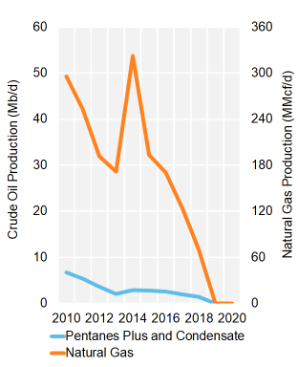
Figure 1: Hydrocarbon Production
Source and Description:
Source:
CER – Canada's Energy Future 2021 Data AppendicesDescription:
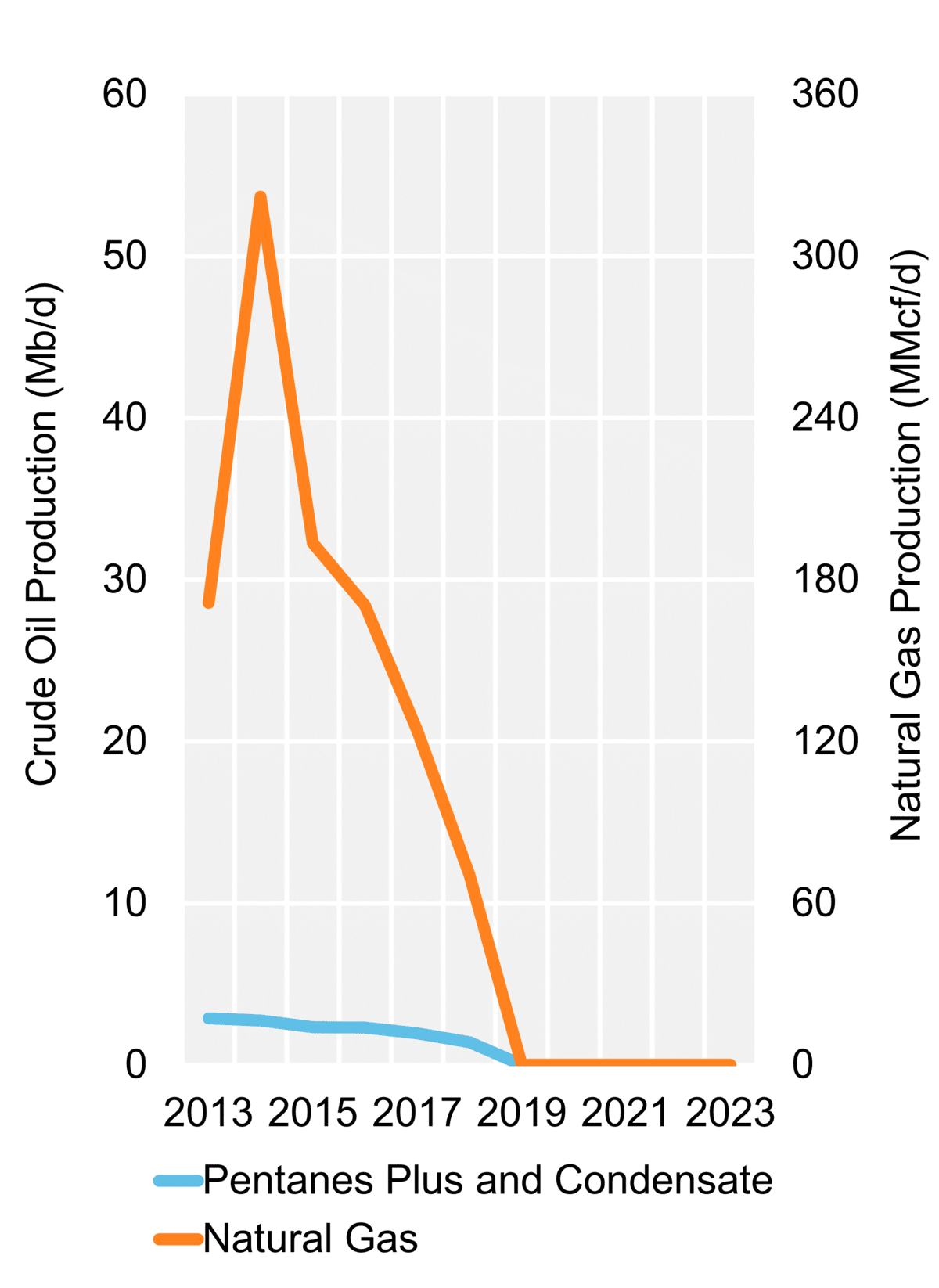
This graph shows hydrocarbon production in Nova Scotia from 2010 to 2020. Over this period, condensate and pentanes plus production has decreased from 6.7 Mb/d to zero. Natural gas production has deceased over this period from around 295 MMcf/d to zero. -
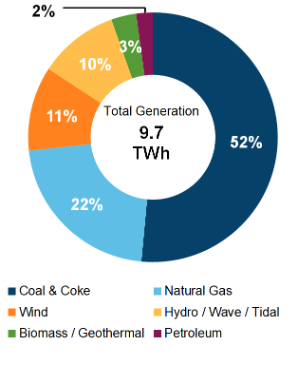
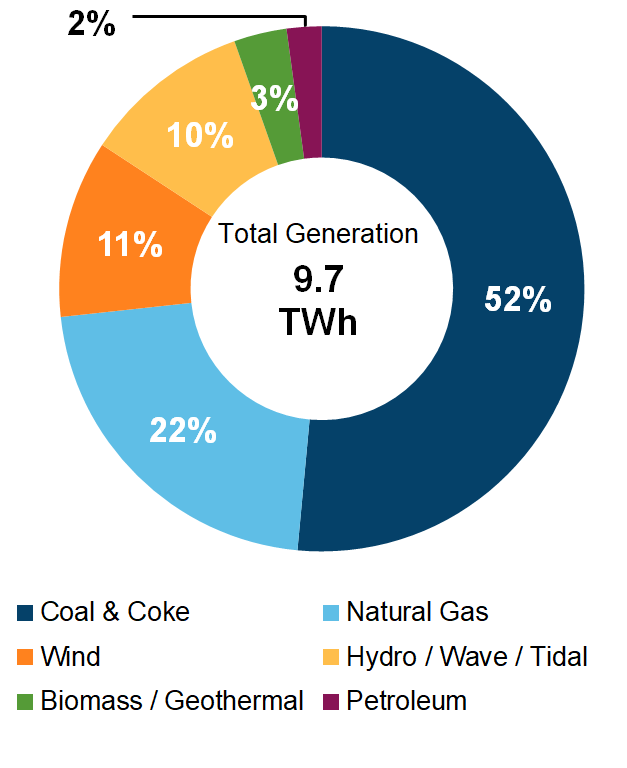
Figure 2: Electricity Generation by Fuel Type (2019)
Source and Description:
Source:
CER – Canada's Energy Future 2021 Data AppendicesDescription:
This pie chart shows electricity generation by source in Nova Scotia. A total of 9.7 TW.h of electricity was generated in 2019. -
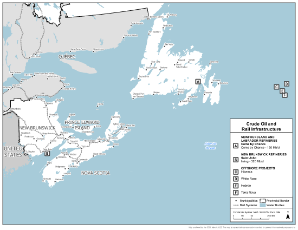
Figure 3: Crude Oil Infrastructure Map
Source and Description:
Source:
CERDescription:
This map shows all rail lines in Nova Scotia and crude oil infrastructure in Atlantic Canada.Download:
PDF version [1 156 KB] -
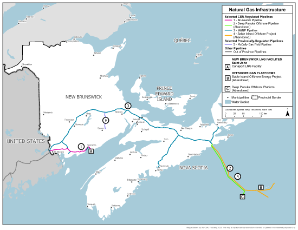
Figure 4: Natural Gas Infrastructure Map
Source and Description:
Source:
CERDescription:
This map shows all major natural gas pipelines,offshore natural gas platforms, and the Canaport LNG terminal in the Maritimes.Download:
PDF version [877 KB] -
Figure 5: End-Use Demand by Sector (2019)
Source and Description:
Source:
CER – Canada's Energy Future 2021 Data AppendicesDescription:
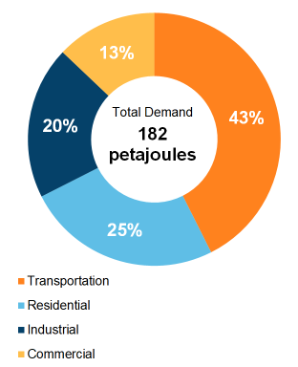
This pie chart shows end-use energy demand in Nova Scotia by sector. Total end-use energy demand was 182 PJ in 2018. The largest sector was transportation at 43% of total demand, followed by residential (at 25%), industrial (at 20%), and lastly, commercial (at 13%). -
Figure 6: End-Use Demand by Fuel (2019)
Source and Description:
Source:
CER – Canada's Energy Future 2021 Data AppendicesDescription:
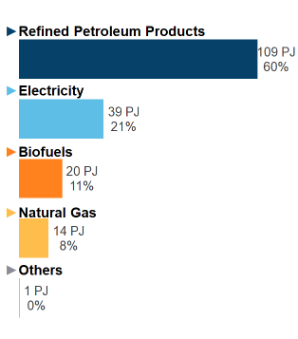
This figure shows end-use demand by fuel type in Nova Scotia in 2018. Refined petroleum products accounted for 106 PJ (60%) of demand, followed by electricity at 39 PJ (23%), biofuels at 20 PJ (11%), natural gas at 14 PJ (8%), and other at 1 PJ.
Note: "Other" includes coal, coke, and coke oven gas. -
Figure 7: GHG Emissions by Sector
Source and Description:
Source:
Environment and Climate Change Canada – National Inventory ReportDescription:
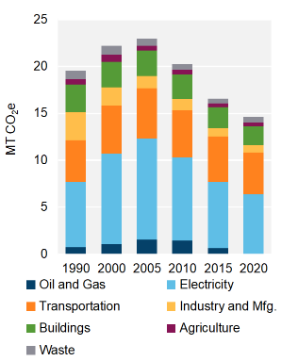
This stacked column graph shows GHG emissions in Nova Scotia by sector every five years from 1990 to 2020 in MT of CO2e. Total GHG emissions have decreased in Nova Scotia from 19.5 MT of CO2e in 1990 to 14.6 MT of CO2e in 2020. -
Figure 8: Emissions Intensity from Electricity Generation

Source and Description:
Source:
Environment and Climate Change Canada – National Inventory ReportDescription:
This column graph shows the emissions intensity of electricity generation in Nova Scotia from 1990 to 2020. In 1990, electricity generated in Nova Scotia emitted 720 g of CO2e per kWh. By 2020, emissions intensity decreased to 670 g of CO2e per kWh.


Energy Production
Crude Oil
- Since 2018, Nova Scotia has not produced any crude oil or crude oil equivalents (Figure 1). Between 2000 and 2018, Nova Scotia produced condensate/pentanes plus at the ExxonMobil-operated Point Tupper Fractionator Plant.
- In 2018, ExxonMobil applied to the province to abandon its fractionator as part of the abandonment of its natural gas producing Sable Offshore Energy Project (Sable Island). Production at Point Tupper ceased by May 2018.
- BP Canada’s Scotian Basin Exploration Project, located approximately 330 kilometres (km) off the southeast coast of Nova Scotia, commenced exploration drilling in April 2018. The first well was plugged and abandoned in December 2018 after it did not produce commercial quantities of oil or gas. BP Canada’s exploration licence expired in January 2022.
Refined Petroleum Products (RPPs)
- Nova Scotia does not have any refineries. Imperial Oil’s Dartmouth refinery closed in 2013. The facility now operates as an oil products terminal.
- The NuStar terminal in Point Tupper is one of the largest RPP storage and blending facilities in Atlantic Canada. This terminal serves markets in Atlantic Canada and the United States (U.S.) East Coast.
Natural Gas/Natural Gas Liquids (NGLs)
- Offshore natural gas production was terminated by December 2018. Since then, Nova Scotia has not produced any natural gas. (Figure 1)
- Natural gas in Nova Scotia was previously produced offshore at Sable Island and Encana’s Deep Panuke project (Encana renamed itself to Ovintiv in 2020).
- Sable Island, Canada’s first offshore natural gas project, was commissioned in 1999 and ceased production on 31 December 2018. The plugging and abandonment of all wells was completed in 2019.
- Deep Panuke was commissioned in 2013 and ceased production in May 2018. The plugging and abandonment of Deep Panuke’s five wells was completed in August 2020.
- A post-abandonment monitoring program for both Sable Island and Deep Panuke commenced in the summer of 2021 to re-confirm the integrity of the well plugging and abandonment program.
- Since the shutdown of Nova Scotia offshore gas production, the Maritimes now rely on natural gas imported from the U.S., as well as liquefied natural gas (LNG) delivered to the Canaport import terminal in Saint John, New Brunswick.
- Nova Scotia currently produces no NGLs. Previously, NGLs were produced from Sable Island natural gas processed at the Goldboro gas plant. NGLs from Goldboro were then shipped by pipeline to the Point Tupper plant for fractionation into propane, butane, and condensate. Infrastructure associated with gas production, including the gas plant, pipeline, and fractionation plant, have also been shut down.
- Since 2012, a moratorium on hydraulic fracturing has been in place in Nova Scotia.
- Nova Scotia’s offshore production is regulated by the Canada-Nova Scotia Offshore Petroleum Board.
Electricity
- In 2019, Nova Scotia generated 9.7 terawatt-hours (TWh) of electricity (Figure 2), which is 1.5% of total Canadian generation. Nova Scotia has an estimated generating capacity of 3 061 megawatts (MW).
- Nova Scotia’s primary source of electricity generation is coal, accounting for 51% of the province’s total generation in 2019. Nova Scotia also produces electricity from oil, natural gas, hydro, wind, and biomass.
- Nova Scotia’s coal and coke generating stations include Lingan (620 MW), Point Aconi (171 MW), Point Tupper (154 MW), and Trenton (307 MW).
- On 5 November 2021, the province passed the Environmental Goals and Climate Change Reduction Act, a successor to 2007’s Environmental Goals and Sustainable Prosperity Act. The new act outlines numerous climate change objectives over the next decade, including a phase-out of coal-fired electricity generation by 2030.
- Nova Scotia’s share of generation from renewable sources has grown from 16% in 2005 to 25% in 2019.
- Nova Scotia Power, a subsidiary of Emera, generates most of Nova Scotia’s electricity, with 2 400 MW of capacity. Nova Scotia Power operates 33 hydroelectric plants on 17 hydro river systems across Nova Scotia, totaling 400 MW of generation capacity. Nova Scotia Power also operates a 60 MW biomass plant in Port Hawkesbury that provides as much as 3% of the province’s electricity.
- There are now more than 300 commercial wind turbines generating electricity in Nova Scotia. Most wind facilities are owned by independent power producers.
- The Annapolis Tidal Station is currently the only tidal power generating station in North America. Built in 1984, it has 20 MW of generating capacity.
- Fundy Ocean Research Centre for Energy (FORCE) is a not-for-profit research centre for in-stream tidal energy. FORCE partners include the Province of Nova Scotia, the federal government, and tidal energy developers selected by the province. FORCE has a test site located in the Bay of Fundy where several installations are planned. A 9 MW installation is being co-developed by Sustainable Marine Energy and Minas Tidal in the Bay of Fundy. In November 2020, this project received $28.5 million from the federal government and aims to deliver power to Nova Scotia Power in phases starting in 2022.
Energy Transportation and Trade
Crude Oil and Liquids
- There are no crude oil pipelines or crude-by-rail facilities in Nova Scotia.
Natural Gas
- During production years, Nova Scotia’s offshore natural gas production was transported on the Maritimes & Northeast Pipeline (M&NP), which extends through Nova Scotia to the border near St. Stephen, New Brunswick, where gas was exported to serve the Northeast U.S. market (Figure 3).
- M&NP also imports gas from the U.S. Northeast during times of peak demand. Although historically exports have exceeded imports, this changed in recent years because of declining Nova Scotia offshore production. In 2019, M&NP imported 146 MMcf/d, while only exporting 0.2 MMcf/d.
- Alton Natural Gas Storage LP, a subsidiary of AltaGas, had received environmental approval from the province to develop a natural gas underground storage facility near Alton. The project involved a connection to M&NP and consisted of several storage caverns from underground salt formations. In October 2021, AltaGas decided not to continue with development of the project and commenced with decommissioning.
Liquefied Natural Gas (LNG)
- Export and import authorizations for three large-scale LNG projects in Nova Scotia have received NEB (now CER) approval: Bear Head LNG Corp., A C LNG, and Pieridae Energy Ltd. Both Bear Head and Pieridae’s Goldboro LNG projects have received regulatory approval from the Nova Scotia Utilities and Review Board (NSUARB) to construct their facilities.
- To date, none of these projects have started construction. All of these LNG export facilities would be primarily regulated by the NSUARB.
- Pieridae Energy had set a final investment decision date of June 2020 for the Goldboro LNG project; however, after cost pressures and delays, the company has said it will assess options and analyze strategic alternatives. Bear Head LNG was granted an extension on its construction permit until 31 December 2022 by the NSUARB.
Electricity
- Nova Scotia received a net 0.8 TWh of electricity from other provinces in 2019. In 2019, Nova Scotia’s net inflows accounted for almost 7% of total electricity consumed in the province.
- A 350 MW transmission line connects Nova Scotia with New Brunswick, enabling the trade of electricity between the two provinces.
- Nova Scotia Power is responsible for power transmission and distribution in the province. It serves more than 520 000 residential, commercial, and industrial customers. Nova Scotia Power is regulated by the NSUARB.
- Nova Scotia has roughly 32 000 km of transmission and distribution lines.
- The Maritime Link Project was placed into service in January 2018 and connects Nova Scotia’s electrical grid with the Muskrat Falls hydro facility in Labrador. First power from Muskrat Falls was received by Nova Scotia in August 2021. Deliveries of electricity ramped up to between 70% and 100% of contracted amounts starting mid-December 2021.
- Hydro power delivered through the Maritime Link will displace some of Nova Scotia’s thermal generation. The project includes more than 300 km of overland transmission on the island of Newfoundland, two 170 km subsea cables across the Cabot Strait, and 50 km of overland transmission in Nova Scotia.
Energy Consumption and Greenhouse Gas (GHG) Emissions
Total Energy Consumption
- End-use demand in Nova Scotia was 175 petajoules (PJ) in 2019. The largest sector for energy demand was transportation at 44% of total demand, followed by residential at 26%, industrial at 16%, and commercial at 14% (Figure 4). Nova Scotia’s total energy demand was the tenth largest in Canada, and the eleventh largest on a per capita basis.
- RPPs, including gasoline, diesel, and heating oil, were the largest fuel type consumed in Nova Scotia, accounting for 107 PJ, or 61% of total end-use demand. Electricity and biofuels accounted for 38 PJ (22%) and 18 PJ (10%), respectively (Figure 5).
Refined Petroleum Products
- Nova Scotia’s motor gasoline demand in 2019 was 1 420 litres per capita, 12% above the national average of 1 268 litres per capita.
- Nova Scotia’s diesel demand in 2019 was 715 litres per capita, 16% below the national average of 855 litres per capita.
- Gasoline consumed in Nova Scotia is primarily imported from refineries in the U.S. East Coast region.
- RPP prices in Nova Scotia have been regulated by the NSUARB since 2009. The NSUARB sets wholesale prices, minimum and maximum retail mark-ups, and maximum retail prices, including for gasoline and diesel.
Natural Gas
- In 2020, Nova Scotia consumed an average of 84.6 MMcf/d of natural gas, which represented less than 1% of total Canadian demand.
- Nova Scotia’s largest consuming sector for natural gas was the industrial sector, which consumed 64.3 MMcf/d in 2020. The commercial and residential sectors consumed 19.5 MMcf/d and 0.8 MMcf/d, respectively.
Electricity
- In 2019, annual electricity consumption per capita in Nova Scotia was 10.9 megawatt-hours (MWh). Nova Scotia ranked eighth in Canada for per capita electricity consumption and consumed 27% less than the national average.
- Nova Scotia’s largest consuming sector for electricity in 2019 was residential at 4.7 TWh. The commercial and industrial sectors consumed 3.6 TWh and 2.3 TWh, respectively.
- As part of Nova Scotia’s 2010 Renewable Electricity Regulations, the province committed to sourcing 25% of its electricity consumed from renewables with the aim of at least 40% from renewables by 2020. This target was based on the delivery of hydropower from Labrador’s Muskrat Falls, which remained incomplete in 2020. A new plan with Nova Scotia Power now aims for 40% of electricity sourced from renewables, including imports, by 2022.
GHG Emissions
- Nova Scotia’s GHG emissions in 2020 were 14.6 megatonnes (MT) of carbon dioxide equivalent (CO2e).Footnote 1 Nova Scotia’s emissions have declined 25% since 1990 and 36% since 2005.
- Nova Scotia emissions per capita are 14.9 tonnes CO2e – 16% below the Canadian average of 17.7 tonnes per capita.
- The largest emitting sectors in Nova Scotia are electricity generation at 43% of emissions, transportation at 30%, and buildings (residential and commercial) at 14% (Figure 6).
- In 2020, Nova Scotia’s power sector emitted 6.3 MT CO2e emissions, which represents about 11% of Canadian emissions from power generation.
- The greenhouse gas intensity of Nova Scotia’s electricity grid, measured as the GHGs emitted in the generation of the province’s electric power, was 670 grams of CO2e per kilowatt-hour (g of CO2e/kWh) electricity generated in 2020. This is a 24% reduction from the province’s 2005 level of 880 g of CO2e/kWh. The national average in 2020 was 110 g of CO2e/kWh (Figure 7).
More Information
- Canada-Nova Scotia Offshore Petroleum Board
- Nova Scotia Department of Energy
- CER–Canada's Renewable Power: Nova Scotia
- CER–Market Snapshot: Household expenditures on energy are highest in Atlantic Canada
- CER–Market Snapshot: The end of natural gas production in the Maritimes increases reliance on imports
- CER–Market Snapshot: Why do electricity rates change throughout the day in Ontario and Nova Scotia?
- CER–Market Snapshot: 25 Years of Atlantic Canada Offshore Oil & Natural Gas Production
- CER–Market Snapshot: Some Canadian provinces have already met their 2030 GHG emissions targets
- CER–Market Snapshot: Understanding the Regulation of Gasoline Prices in Atlantic Canada
- CER–Market Snapshot: Household energy expenditures highest in the Atlantic region, lowest in British Columbia
- CER–Market Snapshot: Canadian tidal power capacity fourth in the world, with potential to add up to 7 000 MW more
Data Sources
Provincial & Territorial Energy Profiles aligns with the CER’s latest Canada's Energy Future 2021 Data Appendices datasets. Energy Futures uses a variety of data sources, generally starting with Statistics Canada data as the foundation, and making adjustments to ensure consistency across all provinces and territories.
- Date modified: