
Reconciliation

"I’m proud to be part of an organization committed to Reconciliation. Step by step, we’re building lasting relationships, weaving Indigenous perspectives into our work, and creating a more inclusive future together."
Our commitment to Reconciliation
The CER’s Strategic Plan integrates the United Nations Declaration on the Rights of Indigenous Peoples through its Reconciliation & Implementing the UN Declaration priority, focusing on aligning with the Government of Canada’s UNDA Action Plan and enhancing Indigenous participation in energy regulation. The Reconciliation and Implementing the UN Declaration Strategic Priority states:
We are implementing the United Nations (UN) Declaration on the Rights of Indigenous Peoples (UN Declaration) and delivering on the commitments made in the UN Declaration Act Action Plan. We do so based on the recognition of rights, respect, co- operation and partnership, by working together with First Nations, Inuit and Métis governments, communities, and organizations. We continue to build the cultural intelligence of the CER.
CER Statement on Reconciliation
The CER recognizes that Reconciliation is a journey. The CER has developed a Reconciliation Statement, to underpin the CER Reconciliation Strategic Priority. This Statement contains a series of Guiding Principles and Values that were developed to serve as guideposts for the CER as we continue this important journey. These Guiding Principles and Values will help to frame the implementation of the CER’s Reconciliation Strategic Priority, foster a shared understanding of the role the CER can play in advancing Reconciliation, and help to drive CER behaviours as this work is advanced.
Journey to Reconciliation

Come along on our journey to advance Reconciliation as we work to integrate Indigenous perspectives in our work.
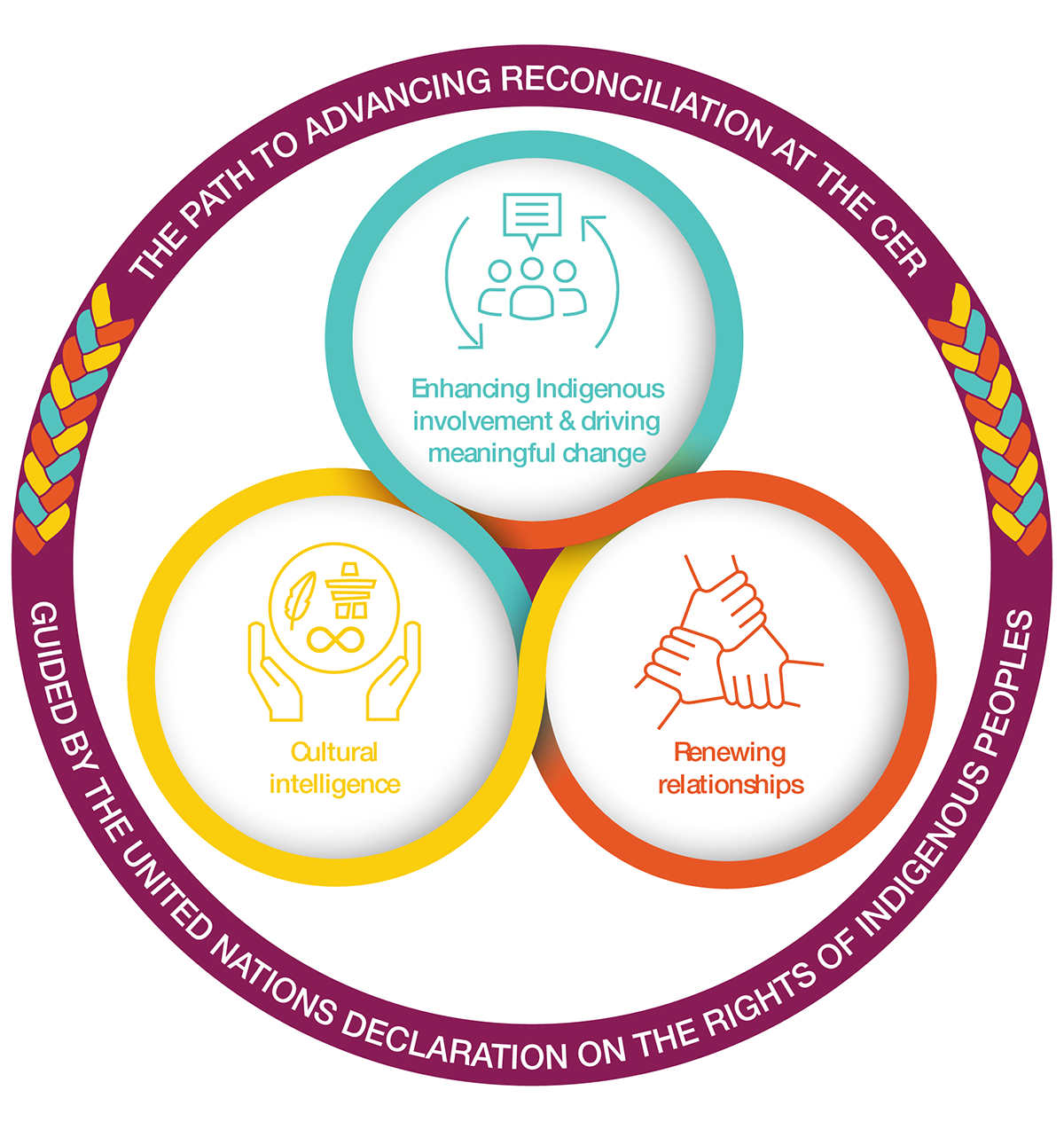
The graphic on the right visually represents the CER’s Path to Advancing Reconciliation, that has a focus on three key areas, all of which are guided by the United Nations Declaration on the Rights of Indigenous Peoples.
View description
The visual representation of the CER’s Path to Advancing Reconciliation is shown by three smaller intertwined circles in a triangular arrangement, positioned inside one larger circle. Each of the three smaller circles surrounds an icon that represent a focus area for the CER: first, a blue circle represents ‘Enhancing Indigenous involvement & driving meaningful change’; second, a yellow circle represents ‘Cultural intelligence’; and lastly, an orange circle represents ‘Renewing relationships’. None of the circles close, rather each connects and feeds into the neighboring circle, representing the interconnectedness of each of the focus areas. The colors acknowledge Indigenous peoples’ connection to, and intimate relationship with, the elements of nature (blue symbolizing water, orange - earth or fire, and yellow – wind). The outer circle, dark purple in color depicts how the CER is weaving the United Nations Declaration on the Rights of Indigenous Peoples into everything that they do and encompasses braids that weave together blue, yellow and orange. The purple color also shadows the inner circles which further demonstrate that the UN Declaration in woven into all the CER’s actions towards Reconciliation. Taken as a whole, the image portrays how the CER views its journey towards Reconciliation.
Imagining our future
Enhancing Indigenous involvement & driving meaningful change
Learn about how we’re enhancing Indigenous involvement in our work as a regulator

Renewing relationships
Join us in building renewed relationships with Indigenous Peoples across Canada

Improving cultural intelligence
See how we plan to improve our awareness of Indigenous cultures - helping our staff discover, learn and grow

Leadership statements on Reconciliation

"Since joining the board in 2019, I’ve seen the CER make meaningful progress in building trust with Indigenous Peoples and diverse communities. While there’s more to do, our dedicated staff, leaders, and partners are driving lasting, positive change."
"Reconciliation for me is having Canadians learn about and embrace that First Nations, Inuit, and Métis rights are different than those of other Canadians. Our rights are about self-reliance and self-determination built on the strengths of our unique languages, cultures, and spiritualties."

- Date modified: