
Provincial and Territorial Energy Profiles – Canada
Update in progress
An update to these profiles will launch in Summer 2024. For current data and information, please visit:
- Canada's Energy Future data appendices tool
- Environment and Climate Change Canada's GHG Emissions Inventory

Connect/Contact Us
Please send comments, questions, or suggestions to
energy-energie@cer-rec.gc.ca
Table of Contents
-
Figure 1: Hydrocarbon Production
Source and Description:
Source:
CER – Canada's Energy Future 2021 Data AppendicesDescription:
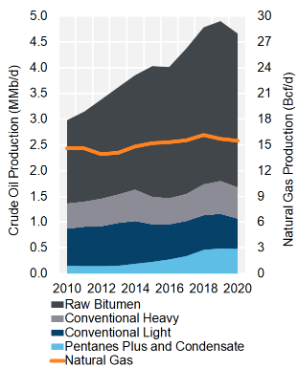
This graph shows hydrocarbon production in Canada from 2010 to 2020. Over this period, crude oil production grew from 3.0 MMb/d to 4.7 MMb/d, with almost all growth coming from the oil sands. Natural gas production increased from 14.6 Bcf/d to 15.5 Bcf/d. -
Figure 2: Electricity Production (2019)
Source and Description:
Source:
CER – Canada's Energy Future 2021 Data AppendicesDescription:
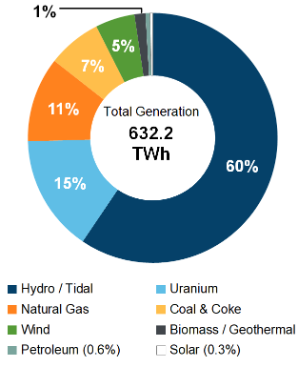
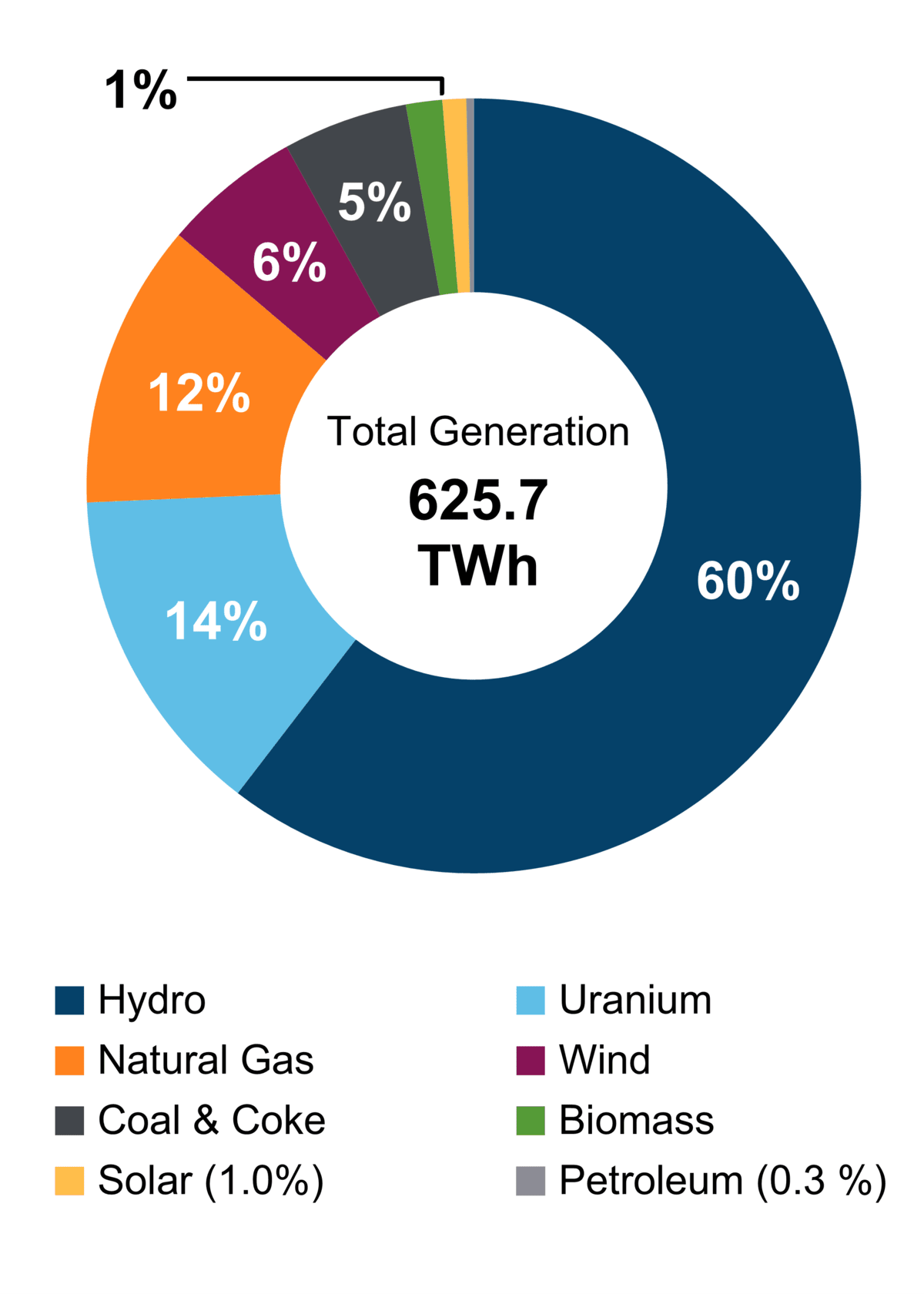
This pie chart shows electricity generation by source in Canada. A total of 632.2 TW.h of electricity was generated in 2019. -
Figure 3: Crude Oil Infrastructure Map
Source and Description:
Source:
CERDescription:
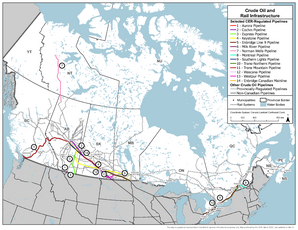
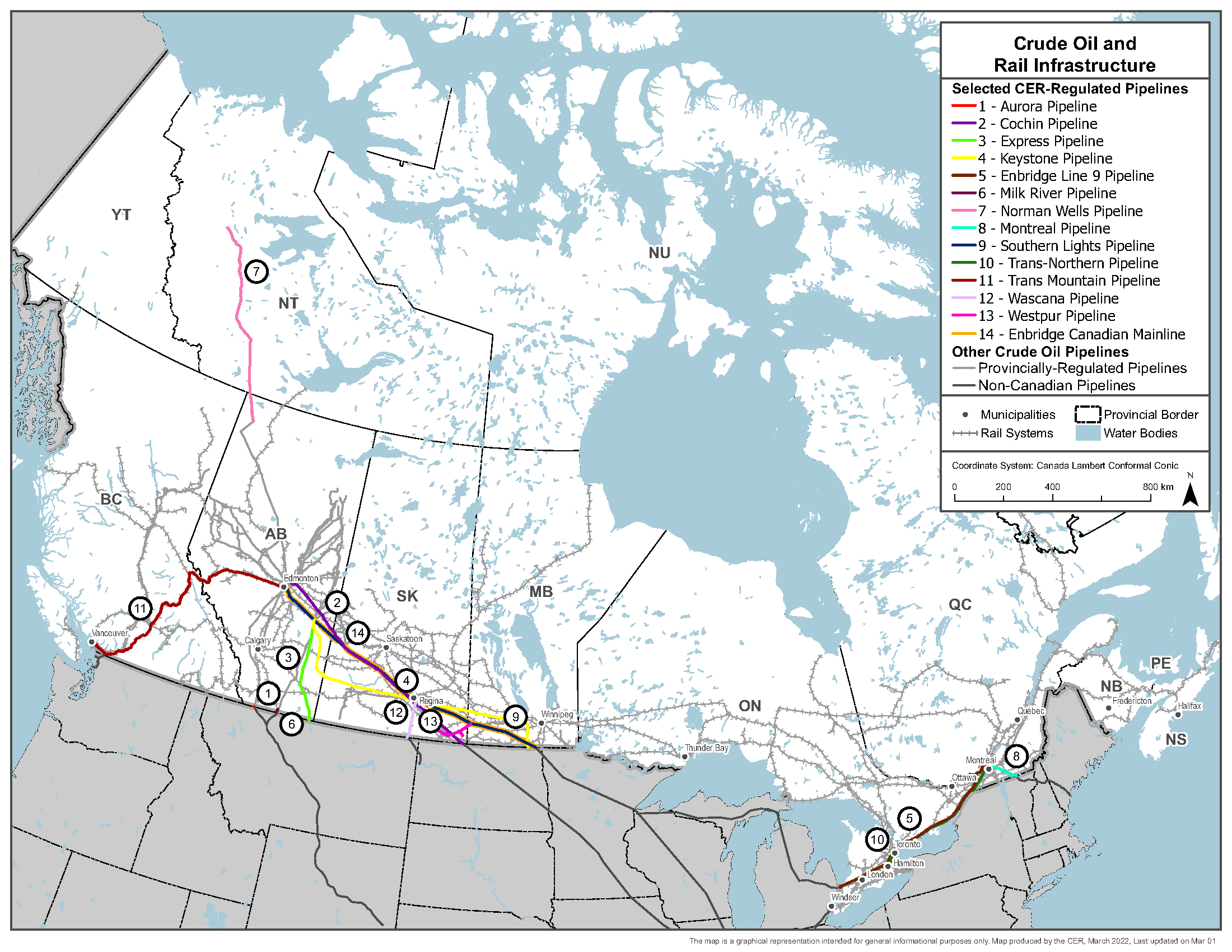
This map shows all major crude oil pipelines and rail lines in Canada.Download:
PDF version [1 810 KB] -
Figure 4: Natural Gas Infrastructure Map
Source and Description:
Source:
CERDescription:
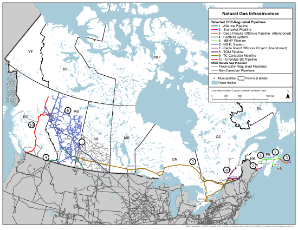
This map shows all major natural gas pipelines in Canada.Download:
PDF version [2 166 KB] -
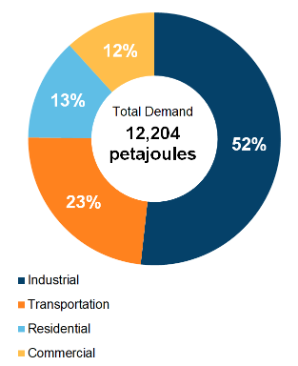
Figure 5: End-Use Demand by Sector (2019)
Source and Description:
Source:
CER – Canada's Energy Future 2021 Data AppendicesDescription:
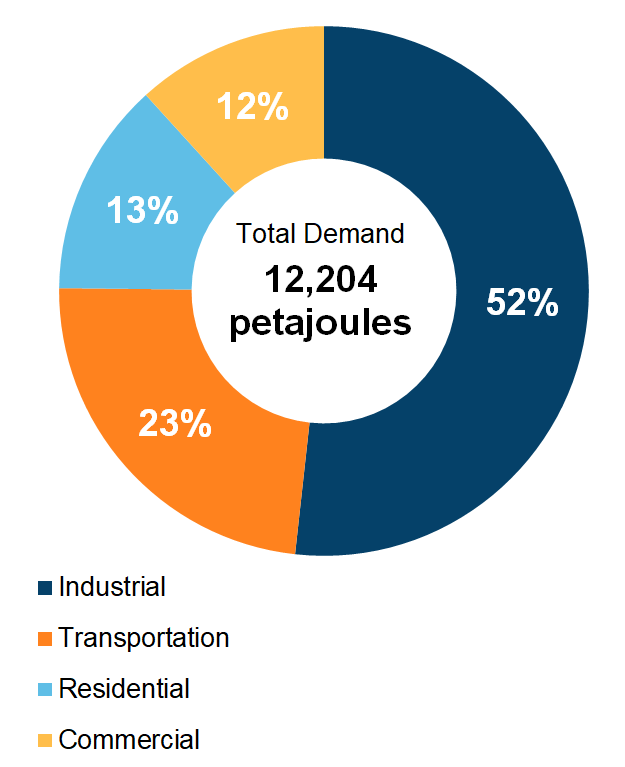
This pie chart shows end-use energy demand in Canada by sector. Total end-use energy demand was 12 204 PJ in 2018. The largest sector was industrial at 52% of total demand, followed by transportation (at 23%), residential (at 13%), and lastly, commercial (at 12%). -
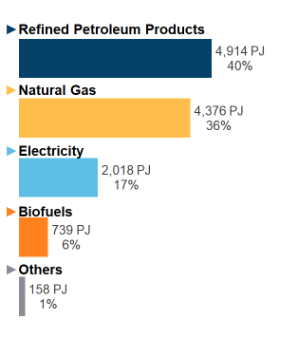
Figure 6: End-Use Demand by Fuel (2019)
Source and Description:
Source:
CER – Canada's Energy Future 2021 Data AppendicesDescription:
This figure shows end-use demand by fuel type in Canada in 2018. Refined petroleum products accounted for 4 914 PJ (40%) of demand, followed by natural gas at 4 376 PJ (36%), electricity at 2 018 PJ (17%), biofuels at 739 PJ (6%), and other at 158 PJ (1%).
Note: "Other" includes coal, coke, and coke oven gas. -
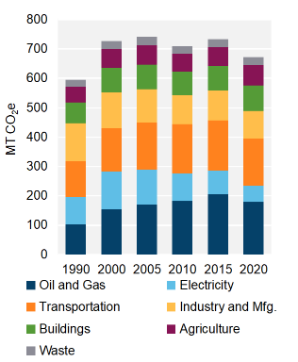
Figure 7: GHG Emissions by Sector
Source and Description:
Source:
Environment and Climate Change Canada – National Inventory ReportDescription:
This stacked column graph shows GHG emissions in Canada every five years from 1990 to 2020 in MT of CO2e. Total GHG emissions have increased in Canada from 595 MT of CO2e in 1990 to 672 MT of CO2e in 2020. -
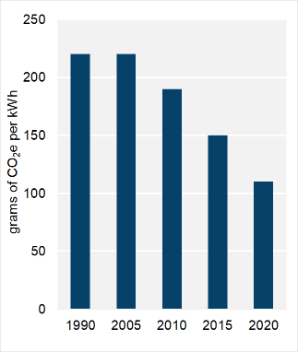
Figure 8: Emissions Intensity of Electricity Generation
Source and Description:
Source:
Environment and Climate Change Canada – National Inventory ReportDescription:
This column graph shows the emissions intensity of electricity generation in Canada from 1990 to 2020. In 1990, electricity generated in Canada emitted 220 g of CO2e per kWh. By 2020, emissions intensity declined to 110 g of CO2e per kWh.




Energy Production
Crude Oil
- Canada produced 4.66 million barrels per day (MMb/d) of crude oil in 2020, a decline of 5% from 2019 (Figure 1). This ranked Canada as the fourth largest oil producer in the world. Since 2010, Canada’s crude oil production has increased 57%.
- Canadian production is centered in western Canada, which accounted for about 95% of total production in 2020. The remaining 5% was produced mostly in Newfoundland and Labrador.
- Alberta, Saskatchewan, and Newfoundland produce 96% of Canada’s oil. These three are also the only provinces that produce heavy oil.
- Canada’s crude oil goes primarily to export markets. In 2020, Canada exported an average of 3.66 MMb/d, a 2.7% decrease from 2019 driven by declines in demand due to the pandemic. Since 2010, exports have increased 87%.
- Canada holds some of the largest oil reserves in the world (almost 10%) and is surpassed only by Venezuela and Saudi Arabia as of 2020.
- In 2020, 75% of total Canadian production, or 3.50 MMb/d was exported to the United States (U.S.). Of the remaining 25%, 21% was refined within Canada and the remainder was exported directly to other countries.
Refined Petroleum Products (RPPs)
- RPPs are a range of products that are refined from crude oil, such as gasoline, diesel, heating oil, and jet fuel. RPPs are the largest type of energy consumed by end users in Canada.
- Canada has 17 refineries with a total capacity of approximately 2.0 MMb/d, as of 2020. Alberta has the largest share of refining capacity (27%), followed by Ontario (20%), Quebec (19%), New Brunswick (16%), Saskatchewan (8%), Newfoundland and Labrador (7%), and British Columbia (B.C.) (3%).
- In 2020, Canadian refineries operated on average at 76% capacity, and consumed 1.5 MMb/d of crude oil, a decrease from 2019, resulting from weaker demand during the pandemic. In 2019, Canadian refineries operated on average at 84% of capacity and consumed 1.7 MMb/d of crude oil.
- The Irving Oil Refinery in Saint John, New Brunswick, is Canada’s largest refinery, with a capacity of 320 000 barrels per day (Mb/d).
- The refinery in Come by Chance, Newfoundland, was idled by owner North Atlantic in March 2020. In July 2021, a U.S.-based private equity firm bought a controlling share in the facility with plans to convert the refinery to produce renewable fuels starting mid-2022.
- The Sturgeon Refinery in Redwater, Alberta, is Canada’s first refinery to be constructed since 1984. It features carbon capture and storage technology and captures up to 1.3 million tonnes of carbon per year to be transported on the Alberta Carbon Trunk Line (ACTL).
Natural Gas/Natural Gas Liquids (NGLs)
- In 2020, Canada was the sixth largest natural gas producer in the world, with production averaging 15.5 billion cubic feet per day (Bcf/d), a 1.6% decline from 2019 (Figure 1).
- Alberta and B.C. accounted for almost 98% of Canadian production in 2020. Smaller amounts of natural gas are produced in Saskatchewan, New Brunswick, Ontario, and the Northwest Territories (NWT).
- In 2020, Canada’s production of natural gas liquids (NGLs) was about 812 Mb/d, not including condensate and pentanes plus, which are included with crude oil. Half of this production was from Alberta.
- Nova Scotia’s natural gas and NGL production ended in December 2018 with the shutdown of the Sable Offshore Energy Project.
Electricity
- In 2019, Canada produced 632.2 terawatt-hours (TWh) of electricity. More than half of the electricity in Canada (60%) is generated from hydro sources. The remainder is produced from a variety of sources, including natural gas, nuclear, wind, coal, biomass, solar, and petroleum (Figure 2). In 2020, Canada had the fourth largest installed capacity of hydropower in the world.
- Regulation of the electricity sector is primarily at the provincial level. This includes most policies related to pricing as well as the types of power generation used. Each province has jurisdiction over electricity generation, intra-provincial transmission, and distribution while the federal government has authority over some aspects of the nuclear generation sector, electricity exports, and designated international and inter-provincial transmission lines.
- Either publicly or privately owned utilities, or a mix of the two in the case of Alberta and Ontario, generate and distribute most of the electricity in Canada. Deregulated wholesale electricity markets exist only in Alberta and Ontario.
- Different jurisdictions use different sources for power generation. B.C., Manitoba, Quebec, Newfoundland and Labrador, and Yukon typically generate over 80% of their electricity from hydroelectricity. Ontario, New Brunswick, and NWT rely on various combinations of nuclear, hydro, wind, biomass, coal, natural gas, and petroleum–although not all provinces or territories use all of them. Alberta, Saskatchewan, Nova Scotia, and Nunavut generate most of their electricity from fossil fuels such as coal, natural gas, or petroleum.
- Generation from wind farms and solar photovoltaic panels grew from a negligible amount in 2005 to approximately 5% of total electricity generation in 2019.
- In 2019, Canada’s wind power capacity was roughly 13.2 gigawatts (GW). Most of the wind facilities in Canada are in Ontario, Quebec, and Alberta.
- In 2019, Canada’s had about 2.9 GW of solar power capacity, the majority installed in Ontario. New large solar farms planned, under construction, or completed in Alberta and Saskatchewan are expected to result in Canada’s installed solar capacity growing to 3.6 GW by 2022.
- The CER’s Canada’s Energy Future 2021 report projects that non-hydro renewable electricity capacity in Canada will grow by 83% to 33.3 GW by 2040 in its Current Policies Scenario, and by 239% to 61.8 GW in its Evolving Policies Scenario.
Uranium
- Canada is a world leader in uranium production, accounting for 13% of global production in 2019, down from 22% in 2017. Canada produced 8 165 tonnes of uranium in 2019. Approximately 85% of Canadian production is exported, with the remaining 15% used to fuel reactors in Ontario and New Brunswick.
- Saskatchewan is currently the only uranium producing province in Canada. Uranium was previously mined in Ontario and NWT as well. Production comes mainly from the McArthur River and Cigar Lake mines in northern Saskatchewan.
- Cameco’s McArthur River/Key Lake mine in northern Saskatchewan is the largest high-grade uranium mine in the world. However, production at McArthur River/Key Lake has been suspended for an indeterminate period because of weak global demand. The closure began in February 2018, causing Canada’s share of global uranium production to decline.
- The world’s largest uranium refinery is operated by Cameco and located in Blind River, Ontario. Refined uranium is then shipped to conversion facilities for further manufacturing into fuel.
Hydrogen
- In December 2020, the Government of Canada released its Hydrogen Strategy for Canada. The report focuses on enabling Canada to become a top global producer of low-carbon hydrogen.
- Early success in small hydrogen projects has led to larger, more integrated projects in Canada. Notable early projects such as the Raglan Mine and Bella Coola HARP project have reduced reliance on diesel in remote locations.
- In Alberta, carbon is captured during hydrogen production at the North West Sturgeon Refinery, and Suncor Energy has partnered with ATCO to produce more than 300 000 tonnes per year of low-carbon hydrogen. An investment decision for the project is expected by 2024, and it could be operational by 2028. Fort Saskatchewan is also home to a blending pilot project by ATCO. The project is expected to be completed in the summer of 2022 and would allow ATCO to deliver a blend of natural gas containing up to 5% hydrogen into part of Fort Saskatchewan's residential natural gas distribution network.
- Air Products announced that it plans to build a $1.3 billion facility in Edmonton that will produce hydrogen derived from natural gas, with operations expected to start in 2024.
- In Ontario, the Enbridge-Cummins energy storage facility can store excess renewable energy as hydrogen. In early 2022, Enbridge Gas and Cummins completed a project to blend this hydrogen into the Enbridge Gas natural gas network in Ontario.
- In Bécancour, Quebec, construction has been completed on the world’s largest proton-exchange membrane electrolyzer. The 20 megawatt (MW) electrolyzer will take advantage of Quebec’s hydroelectric resources to produce green hydrogen.
Energy Transportation and Trade
Crude Oil and Liquids
- Canada’s large pipeline system serves both domestic refineries and export markets (Figure 3). The CER regulates all interprovincial and international crude oil pipelines.
- Total crude oil exports in 2020 were 3.7 MMb/d, 2% lower than 2019. The total value of Canada’s crude oil exports in 2020 was almost $60 billion. Although export volumes were relatively flat year over year in 2020, the average price received for exported Canadian crude oil decreased 32%.
- In 2020, Canada exported about 2.8 MMb/d of heavy oil and 0.8 MMb/d of light oil. In 2020, heavy crude oil accounted for 77% of all crude oil exported from Canada. Over the past five years, heavy crude oil exports increased 23%.
- Imports of crude oil decreased by 20% in 2020, from 693 thousand barrels per day (Mb/d) in 2019 to 555 Mb/d. Imports are primarily light crude oil (including condensate) and are mostly imported to refineries in central and eastern Canada.
- In 2020, the Midwest U.S., or PADD II (Petroleum Administration for Defense District region 2), received 58% of Canada’s crude oil exports, making it Canada’s largest market. The U.S. Gulf Coast (PADD III) received 20%. PADD III is Canada’s fastest-growing market, with exports increasing by more than 600% since 2013. This is partly due to declining imports from Venezuela and Mexico–two other suppliers of heavy oil to the U.S.
- In 2020, approximately 88% of crude oil exports moved by pipeline and the remaining crude oil moved by rail, marine, and truck. In 2020, approximately 5% was exported by rail, and 8% was exported by marine vessel.
- The majority of Canada’s crude oil exports are moved by four pipelines: Enbridge’s Canadian Mainline, TC Energy’s (formerly TransCanada) Keystone, Trans Mountain, and Enbridge’s Express.
- Canada has more than 30 crude oil rail loading facilities. Most facilities are in western Canada and have a total estimated loading capacity of 1.4 MMb/d. In 2020, the volume of crude oil exported by rail averaged 170 Mb/d, a decrease from 280 Mb/d in 2019 due to production declines driven by lower demand during the COVID-19 pandemic.
- Canadian refineries are primarily supplied with crude oil by pipeline, but refineries on the East Coast have no pipeline access and rely on marine and rail for supply.
- Alberta’s refineries supply RPPs to the Prairies through Enbridge’s Canadian Mainline and to B.C. through the Trans Mountain Pipeline. Alberta also supplies RPPs to neighbouring provinces by rail and truck.
- Quebec delivers petroleum products primarily to Ontario via the Trans-Northern Pipeline, Canada’s largest interprovincial RPP pipeline, and by rail, ship, and truck.
- Exports of Canadian RPPs are primarily from the Atlantic refineries, though small volumes are exported to the U.S. from all Canadian regions.
- Quebec, Ontario, and the Atlantic provinces are the primary importing regions for RPPs.
- Canada imports condensate from the U.S. on Enbridge’s Southern Lights and Pembina’s Cochin. Condensate imported into Alberta is used primarily as a diluent to allow heavy oil and bitumen to be transported on pipelines.
Natural Gas
- In 2020, Canada exported an average of 6.8 Bcf/d to the U.S. and imported 2.2 Bcf/d. Exports decreased by 7% and imports decreased by 11% between 2019 and 2020. The value of natural gas exports less imports in 2020 was $4.7 billion.
- Canada has a vast network of natural gas pipelines (Figure 4). Natural gas generally flows from production areas in western Canada to higher demand markets in central Canada and the U.S. TC Energy’s Canadian Mainline is the primary long-haul natural gas pipeline in Canada, extending from the NGTL system at the Alberta/Saskatchewan border across Saskatchewan, Manitoba and Ontario, and through a portion of Quebec. Several other interprovincial and international pipelines regulated by the CER also transport Canadian gas to markets. These include Alliance, Westcoast (also known as BC Pipeline), Foothills, Trans-Quebec and Maritimes, Maritimes and Northeast, and Emera Brunswick.
- Almost all Canadian-produced natural gas exported to the U.S. is transported via pipeline, while a very small amount is exported via truck or ship as liquefied natural gas (LNG).
- Most natural gas imports are delivered through pipelines in southern Ontario. Several traditional natural gas export points on the TC Energy Canadian Mainline in southern Ontario have added bi-directional capabilities in recent years, and now operate primarily as import points.
- There is approximately 949 Bcf of underground natural gas storage available in Canada. About 58% of this storage capacity is located throughout Alberta, with much of the remainder located near Sarnia, Ontario. Smaller amounts of underground storage are also present in Saskatchewan, B.C., and Quebec. Natural gas storage is used to provide supply to consuming regions during peak winter demand.
Liquefied Natural Gas (LNG)
- As of May 2021, the CER has approved 43 export licence applications for Canadian LNG projects. LNG export projects have been proposed for both the west and east coasts. Only one of the proposed LNG export facilities has started construction–LNG Canada in Kitimat, B.C. The first shipments from LNG Canada are expected in the mid-2020s.
- Canada has one LNG import terminal–the Canaport terminal in Saint John, New Brunswick, which started up in 2009. Canaport has a natural gas delivery capacity of 1.2 Bcf/d, but actual send-out volumes have been much lower.
- Several provinces and territories house small-scale LNG facilities for a variety of uses, including transportation (including marine and fleet vehicles) and power generation. LNG is also used for providing natural gas during demand peaks (for example, in Delta, B.C.; Sudbury, Ontario; and Montreal, Quebec).
- Canada also exports small volumes of LNG from FortisBC’s Tilbury Island LNG facility to Asia via ship, since late 2017.
Electricity
- Canada is a net exporter of electricity. In 2020, net exports grew to 57.3 TWh, from 47.1 TWh in 2019. All electricity trade was with the U.S.
- In 2020, Canada exported 67.2 TWh of electricity to the U.S and imported 9.8 TWh from the U.S.
- There are 34 major active international transmission lines connecting Canada to the U.S.
- The total value of Canada’s electricity exports was $2.6 billion and the value of imports was $0.3 billion, resulting in 2020 net exports of $2.3 billion. The bulk of electricity trade occurs between the U.S. and the provinces of Quebec, Ontario, Manitoba, and B.C.
- Electricity trade most frequently occurs in a north-south direction, between provinces and states, rather than in an east-west direction between provinces.
Energy Consumption and Greenhouse Gas (GHG) Emissions
Total Energy Consumption
- End-use demand in Canada was 12 305 petajoules (PJ) in 2019. The largest sector for energy demand was industrial at 52% of total demand, followed by transportation at 23%, residential at 13%, and commercial at 12% (Figure 5).
- RPPs were the largest fuel type consumed in Canada in 2019, accounting for 4 953 PJ, or 40% of consumption. Natural gas and electricity accounted for 4 416 PJ (36%) and 2 025 PJ (16%), respectively (Figure 6).
Refined Petroleum Products
- Total demand in Canada for RPPs in 2019 was 4 953 PJ. The primary products consumed were gasoline and diesel. Other products include heavy fuel oil, asphalt, and lubricants.
- Canadians are some of the highest consumers of oil and refined products in the world.
- Per capita consumption of motor gasoline in 2019 was 1 268 litres. Motor gasoline consumption was highest in Saskatchewan at 2 302 litres per capita, and lowest in B.C. at 1 066 litres per capita.Footnote 1
- Per capita consumption of diesel in 2019 was 855 litres. Diesel consumption was highest in Saskatchewan at 3 020 litres per capita, and lowest in Ontario at 513 litres per capita.Footnote 2
- Gasoline in western Canada and Ontario is primarily produced with western Canadian crude oil, while gasoline in Quebec and Atlantic Canada is produced using a mix of western Canadian, offshore Atlantic Canadian, and imported crude oils.
- Growing production, new pipeline capacity, and new rail offloading facilities in eastern Canada have allowed western Canadian and U.S. crude oil to increasingly displace overseas imports by eastern Canadian refineries.
Natural Gas
- Canada consumed an average of 11.4 Bcf/d of natural gas in 2020. The largest consumers of natural gas were Alberta at 6.4 Bcf/d, followed by Ontario and B.C. at 2.7 Bcf/d and 0.8 Bcf/d, respectively.
- Canada’s largest consuming sector for natural gas was the industrial sector, which consumed 8.0 Bcf/d in 2020. The residential and commercial sectors each consumed 1.7 Bcf/d.
Electricity
- In 2019, annual electricity consumption per capita in Canada was 15 megawatt-hours (MWh). Quebec ranked the highest for annual electricity consumption at 24 MWh per capita, and Nunavut ranked the lowest at 6.1 MWh per capita.
- Canada’s largest consuming sector for electricity in 2019 was industrial at 239 TWh. The residential and commercial sectors consumed 171 TWh and 150 TWh, respectively. The transportation sector consumed a negligible amount.
GHG Emissions
- Canada’s GHG emissions in 2020 were 672.4 megatonnes (MT) of carbon dioxide equivalent (CO2e). Canada’s emissions have increased 13.1% since 1990 and declined 9.3% since 2005.Footnote 3
- Canada’s per capita emissions were 17.7 tonnes CO2e in 2020.
- Canada’s share of global annual GHG emissions has been below 2.0% since 1990. Despite this low share, Canada ranks among the highest of the developed nations for GHG emissions per capita, along with Australia, Luxembourg, and the U.S.
- The largest sector for GHG emissions in Canada is oil and gas production, which emitted 179.8 MT CO2e in 2020. Transportation was the second largest emitter with 159.2 MT CO2e, followed by industries and manufacturing at 94.4 MT, and buildings at 87.8 MT (Figure 7).
- Of the 179.8 MT CO2e emitted by the oil and gas sector in 2020, 160.4 MT were attributable to production, processing, and transmission and 18.4 MT were attributable to petroleum refining and natural gas distribution.
- Canada’s GHG emissions from power generation declined 52% between 2005 and 2020. Most of this reduction came from Ontario’s phase-out of coal-fired generation. Between 2005 and 2020, Ontario’s GHG emissions from electricity declined from 33.9 MT CO2e to 3.2 MT.
- Saskatchewan and Alberta are the provinces with the highest emissions from power generation. In 2020, Alberta generated 52% of Canada’s total GHG emissions from power generation and Saskatchewan accounted for 22%.
- The greenhouse gas intensity of Canada’s electricity grid, measured as the GHGs emitted in the generation of the country’s electric power, was 110 grams of CO2e per kilowatt-hour (g of CO2e/kWh) in 2020. This is a 50% reduction from the 2005 level of 220 grams of CO2e/kWh (Figure 8). The EU-27 electricity grid greenhouse gas intensity averaged 231 grams of CO2e/kWh in 2020. The U.S. electricity grid GHG intensity was 386 grams of CO2e/kWh in 2020.
More Information
- CER: Crude Oil Export Summary
- CER: Annual Electricity Exports and Imports Summary
- CER: Annual Natural Gas Exports and Imports Summary
- CER: Crude Oil and Petroleum Products Statistics & Analysis
- CER: Canada’s Energy Future
- CER: Canada's Renewable Power
- CER: Market Snapshots
- Natural Resources Canada
- Environment and Climate Change Canada
- Environment and Climate Change Canada: Canada’s Greenhouse Gas Inventory
- Canadian Association of Petroleum Producers
- Canadian Fuels Association
- Canadian Gas Association
- Canadian Hydrogen Fuel Cell Association
- Canadian Renewable Energy Association
- Canadian Solar Industries Association
Data Sources
Provincial & Territorial Energy Profiles aligns with the CER’s latest Canada's Energy Future 2021 Data Appendices datasets. Energy Futures uses a variety of data sources, generally starting with Statistics Canada data as the foundation, and making adjustments to ensure consistency across all provinces and territories.
- Date modified: